
Timing is everything in migration — and sometimes, the smallest decisions can save hundreds of dollars and months of complexity.
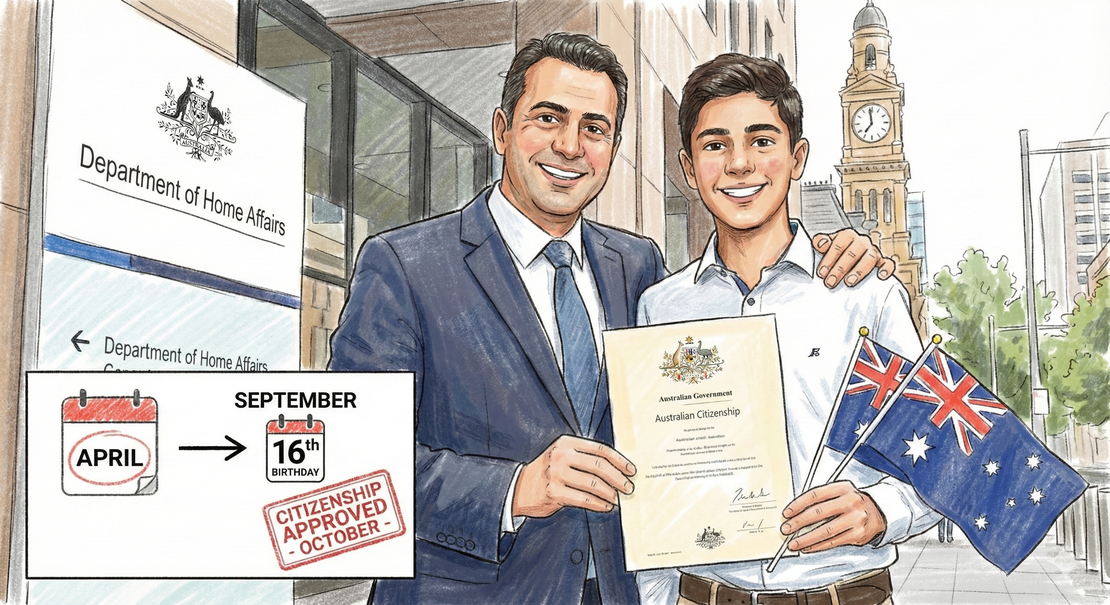
This is the story of a Global Talent Visa holder who applied for Australian citizenship alongside his child. The catch? The child was about to turn 16, and we had just days to lodge before that birthday changed everything.
What followed was a six-month journey with a few twists — a last-minute document request, and ultimately, a successful outcome for the whole family.
The Strategic Decision: Apply Before the 16th Birthday
When our client came to us ready to apply for citizenship, we immediately identified a critical timing factor: his child was approaching their 16th birthday.
Under Australian citizenship law, children under 16 can be included in a parent’s citizenship application without needing to meet separate residency requirements or pay an additional application fee. Once a child turns 16, they’re treated as an adult for citizenship purposes — meaning a separate application, separate fee and potentially separate processing.
The difference in fees alone made the decision clear. A single family application would cost significantly less than two separate applications lodged months apart.
We moved quickly. In April 2025, we lodged the citizenship by conferral application — with just days to spare before the child’s 16th birthday.
Application acknowledged: 17 April 2025.
The timing was tight, but we’d made it.
The Unexpected Twist: Child Turns 16 During Processing
What we hadn’t fully anticipated was how the child’s birthday would create some confusion during processing.
By the time the citizenship test appointment letter arrived in September 2025, the child had already turned 16. This raised an immediate question: would the child need to sit a separate citizenship test?
The letter didn’t mention anything about a separate test for the child. It only referenced the parent’s appointment.
This was genuinely confusing. When a child is included in a parent’s application but turns 16 during processing, the rules become less clear-cut. Would the Department treat them as they were at lodgement (under 16) or as they were now (16 and technically an adult)?
We needed clarification.
Calling the Department: Better Safe Than Sorry
Rather than assume, we picked up the phone and contacted the Department of Home Affairs directly.
Their advice was practical: the child should accompany the parent to the citizenship test appointment, just in case they were needed to confirm their identity or details.
So that’s exactly what happened. Parent and child attended together.
Citizenship test Date: September 2025.
On the day, no separate test was required for the child. No identity confirmation was requested. The appointment proceeded smoothly, with only the parent completing the citizenship test.
It turned out the Department processed the child based on their age at lodgement — under 16 — which meant they remained part of the parent’s application without additional testing requirements.
One More Request: The NCCHC Consent Form
Request for More Information received: 14 October 2025.
Just when we thought everything was on track, a new letter arrived in October 2025 — a Request for More Information from the Department.
The request was straightforward: they needed a signed National Coordinated Criminal History Check (NCCHC) consent form from the parent on behalf of the child.
This is a standard requirement when children approach or turn 16 during processing. Even though the child was included in the parent’s application, the Department needed parental consent to conduct the background check now that the child had crossed the 16-year threshold.
We prepared and submitted the consent form promptly.
From Request to Approval: Six Days
What happened next was remarkably fast.
Just six days after we submitted the NCCHC consent form, the Department made its decision.
Citizenship approved: 20 October 2025.
Both parent and child were approved for Australian citizenship by conferral. A journey that began with strategic timing in April had reached its successful conclusion in October — just over six months from lodgement to approval.
The final step? The invitation to the citizenship ceremony arrived a month later.
Ceremony invitation received: 26 November 2025.
The Complete Timeline
Here’s how the journey unfolded:
| Milestone | Date |
|---|---|
| Application lodged and acknowledged | 17 April 2025 |
| Citizenship test appointment letter | 5 September 2025 |
| Citizenship test completed | September 2025 |
| Request for More Information (NCCHC) | 14 October 2025 |
| Citizenship approved | 20 October 2025 |
| Ceremony invitation received | 26 November 2025 |
| Ceremony Date | 18 December 2025 |
Total processing time: Approximately 6 months from lodgement to approval.
Key Lessons for Citizenship Applicants
This case offers several valuable insights for anyone planning to apply for Australian citizenship — especially families with children approaching 16.
1. Timing Matters More Than You Think
By lodging before the child turned 16, our client avoided a separate application fee and kept the family’s citizenship journey unified. A few weeks’ delay would have meant significantly higher costs and more complex processing.
Takeaway: If you have a child approaching 16, plan your citizenship application timeline carefully. The savings can be substantial.
2. Be Prepared for Age-Related Complications
When a child turns 16 during processing, the Department may need additional documentation — like the NCCHC consent form in this case. This doesn’t mean anything has gone wrong; it’s simply the Department ensuring all requirements are met based on the child’s current age.
Takeaway: Expect potential document requests if your child’s 16th birthday falls during processing. Respond promptly to keep things moving.
3. When in Doubt, Call the Department
The confusion about whether the child needed to attend the citizenship test was easily resolved with a phone call. The Department’s advice to bring the child “just in case” turned out to be the right approach — even though no separate confirmation was needed on the day.
Takeaway: Don’t guess. If something in your citizenship journey is unclear, contact the Department directly for clarification.
4. Children Are Generally Assessed at Lodgement Age
In this case, the child was treated based on their age at the time of lodgement (under 16), not their age during processing. This meant no separate citizenship test was required, and they remained part of the parent’s application throughout.
Takeaway: Lodging before a child’s 16th birthday can simplify requirements, even if they turn 16 during processing.
5. The Process Can Move Quickly After RFI
Once the requested document was submitted, approval came within a week. This demonstrates that responding promptly and completely to Requests for More Information can lead to swift outcomes.
Takeaway: Don’t delay responses to RFIs. Quick, complete submissions often lead to faster decisions.
From GTI to Citizen: The Complete Journey
For this client, Australian citizenship represented the final chapter of a remarkable migration story that began with the Global Talent Visa.
The GTI pathway had already given them permanent residency, work rights, and the stability to build a life in Australia. Citizenship added the final layer: the right to vote, hold an Australian passport, and truly call Australia home.
For their child — now 16 and legally an Australian citizen — the future is wide open. University, career opportunities, travel on an Australian passport — all secured through strategic planning and timely action.
Planning Your Citizenship Application
If you’re a permanent resident considering citizenship, here are the key questions to ask:
Do You Meet the Residency Requirements?
Generally, you need to have:
- Lived in Australia for at least four years (including at least 12 months as a permanent resident)
- Not been absent from Australia for more than 12 months total during the four years
- Children do not have any residency requirements
Are There Children to Include?
If you have children under 16, they can be included in your application without additional fee. Consider timing carefully if any children are approaching their 16th birthday.
Is Your Documentation Ready?
Citizenship applications require:
- Identity documents (passport, birth certificate)
- Evidence of residency
- Travel records
- Character references (if applicable)
Have You Considered Professional Assistance?
While citizenship applications are often simpler than visa applications, strategic considerations — like the timing issue in this case — can make professional guidance valuable.
How Wisekangaroo Can Help
At Wisekangaroo, we assist clients at every stage of their Australian migration journey — from initial visa applications through to citizenship.
We can help you:
- Assess your eligibility for citizenship by conferral
- Plan your timing to maximise benefits, especially for families with children
- Prepare your application with all required documentation
- Navigate requests for additional information
- Coordinate your journey from permanent residency to citizenship
We’re here to help you take the final step to becoming an Australian citizen.
Ready to Apply for Citizenship?
Book a consultation today and let’s plan your pathway to Australian citizenship.
Frequently Asked Questions
Q: Can children under 16 be included in a parent’s citizenship application?
A: Yes. Children under 16 at the time of lodgement can be included in a parent’s citizenship by conferral application. They don’t need to meet residency requirements or pay an additional fee.
Q: What happens if my child turns 16 during citizenship processing?
A: The Department generally assesses children based on their age at lodgement. However, you may receive requests for additional documentation — such as NCCHC consent forms — reflecting their current age.
Q: Do children under 16 need to sit the citizenship test?
A: No. Children included in a parent’s application don’t need to sit the citizenship test or attend an interview. The parent completes these requirements on behalf of the family.
Q: What is the NCCHC consent form?
A: The National Coordinated Criminal History Check (NCCHC) consent form authorises the Department to conduct background checks. For children who are 16 or older, parental consent may be required if they were included in a parent’s application.
Q: How long does citizenship processing take?
A: Processing times vary, but this case was completed in approximately 6 months from lodgement to approval. Current processing times can be checked on the Department of Home Affairs website.
More Success Stories
Inspired by this journey? Read about other clients who’ve achieved their Australian migration and citizenship goals:
- From Student Visa to Australian Citizenship: A Public Health Researcher’s 7-Year Journey
- National Innovation Visa Success: Health Researcher Receives Direct Grant
- HealthTech Entrepreneur Secures National Innovation Visa in Record Time
Last updated: December 2025. Information current as of publication date. Always check the official Department of Home Affairs website for the latest citizenship requirements and processing information.
This article is for general information only. For specific advice about your circumstances, consult a registered migration agent.