
Last updated: 31 July 2026. Based on Department of Home Affairs guidance at Domestic and family violence and your visa and How we can help, the departmental factsheet, and Division 1.5 of the Migration Regulations 1994. Information current as of publication date.
Domestic and Family Violence and Your Visa: Where to Get Help
If you are in immediate danger, call 000. For free, confidential counselling at any hour of any day, call 1800RESPECT on 1800 737 732. If you would prefer to speak in your own language, ask for an interpreter through TIS National on 131 450. It is free.
Family violence has stayed at the front of Australian news and politics for two years now, and the figures behind the coverage keep moving the wrong way. Police recorded 97,800 family and domestic violence offenders in 2024-25, up 8 per cent on the year before and the highest rate since national reporting began in 2019-20, according to the Australian Bureau of Statistics.
Behind those numbers sits a group that rarely makes the headlines. If you are here on a visa, one fear keeps people in violent homes longer than anything else: the belief that leaving means losing your status. The Department of Home Affairs has now published a straight answer to it. Its guidance on domestic and family violence and your visa sets out what help exists, what the law protects, and how to reach a specialist team safely. The factsheet is available in more than a dozen languages.
What the Department is saying
Four points sit at the centre of the guidance.
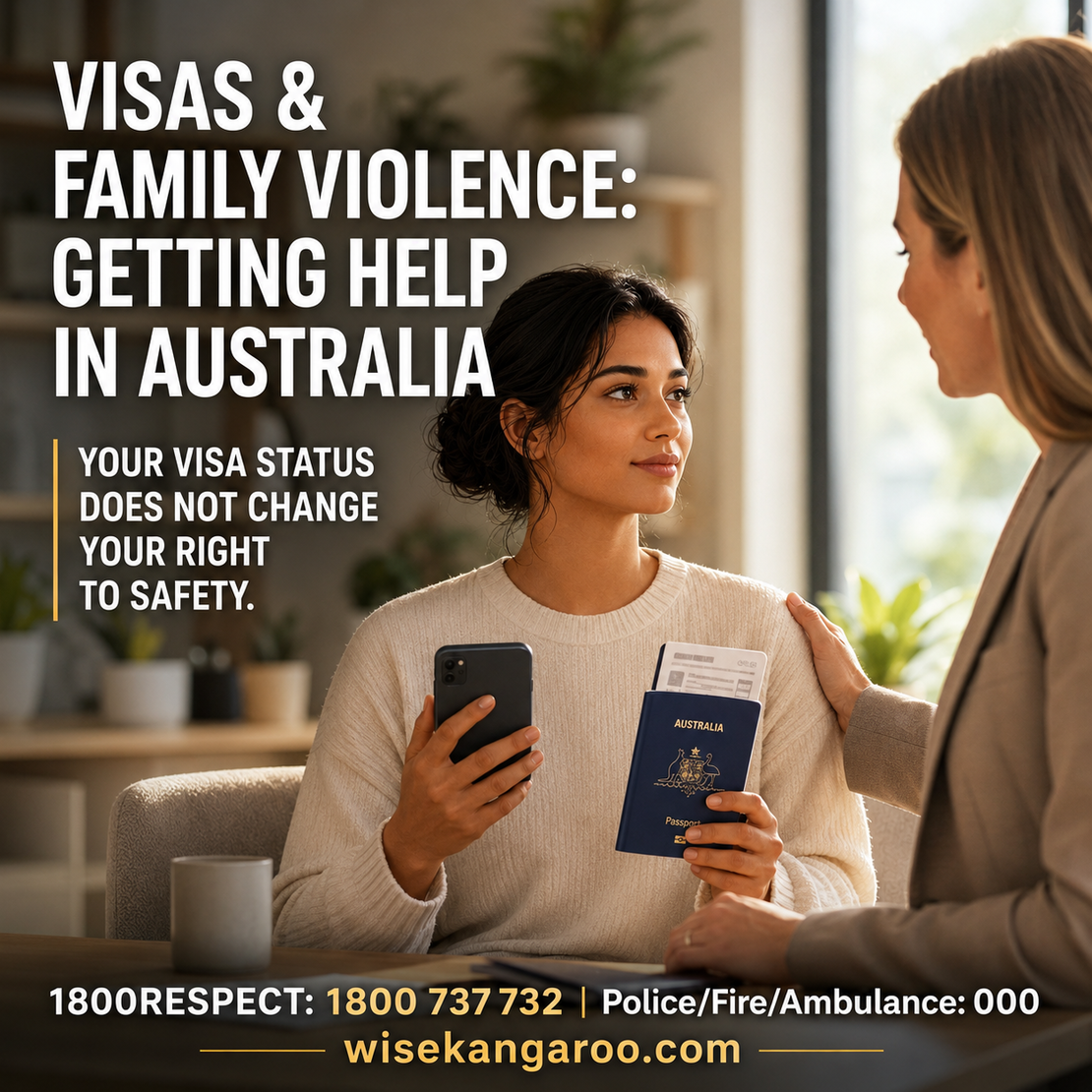
Domestic and family violence is a crime in Australia, whatever visa you hold. Your visa status does not change your right to safety or your right to call the police.
A person who commits family violence cannot cancel your visa. Only the Department decides visa outcomes. A partner threatening to “cancel your visa” is describing a power they do not have. A sponsor can withdraw sponsorship, which is a different thing and does not automatically end your application.
Support is available regardless of your visa status. You do not have to stay in a relationship where you fear for your safety in order to stay in Australia.
If your relationship has ended because of family violence, the family violence provisions may let you continue the application you already lodged. They are not a separate visa, but a way for your existing application to proceed without your former partner.
What counts as family violence
Home Affairs takes a broader view than most people expect. Alongside physical and sexual assault, its guidance recognises:
- Coercive control: patterns of behaviour that isolate you, monitor you, or control your daily life
- Financial abuse: limiting your access to money, including dowry-related demands on you or your family
- Social and technology-facilitated abuse: cutting you off from family and friends, or tracking your movements and messages
- Emotional abuse: behaviour designed to frighten you or make you feel worthless
- Threats about your immigration status: threatening to have your visa cancelled, to withdraw sponsorship, to report you to the Department, or to have you deported
That last one matters, and it is not a rare tactic. Monash University research led by Associate Professor Marie Segrave, drawing on 300 cases of temporary migrants who experienced family violence, found that perpetrators routinely weaponise the migration system itself, using threats of deportation, of being “sent back”, and of separation from their Australian citizen children as instruments of control. If someone has been telling you that your visa is theirs to take away, you are experiencing a documented pattern, not an unlucky relationship.
Why this guidance exists
None of this appeared from nowhere. Australia’s own numbers forced it.
In 2024-25 there were 98 domestic homicide victims in Australia, 46 of them killed by an intimate partner. On average, one woman was killed every 11 days by a current or former partner, according to the Australian Institute of Health and Welfare drawing on the National Homicide Monitoring Program.
For women who arrived here on a visa, the picture is worse again. The first national study of migrant and refugee women in Australia, run by Monash University and Harmony Alliance with almost 1,400 respondents, found one in three had experienced domestic or family violence. Women on temporary visas consistently reported higher rates of controlling behaviour and migration-related threats than those with permanent status.
That evidence is why the government widened the family violence provisions twice in 2024, why the Department now runs a specialist support team, and why the guidance exists in more than a dozen languages. The system was changed because people in your position were being trapped by it.
Which visas the family violence provisions cover
The provisions sit in Division 1.5 of the Migration Regulations 1994 (regulations 1.21 to 1.27). Two rounds of reform in 2024 widened their reach considerably.
Applicants in your own right: the onshore partner visa (subclass 820/801), the offshore partner visa (subclass 309/100), the prospective marriage visa (subclass 300), and the dependent child visa (subclass 445).
Secondary applicants on a much longer list. The Migration Amendment (Family Violence Provisions for Skilled Visa Applications) Regulations 2024, which commenced 15 October 2024, opened the provisions to secondary applicants on seven permanent skilled subclasses: Skilled Independent (189), Skilled Nominated (190), Permanent Residence Skilled Regional (191), Employer Nomination Scheme (186), Regional Sponsored Migration Scheme (187), Skilled Regional (887) and the National Innovation Visa (858). A December 2024 round extended them again, to parent, carer, remaining relative, Pacific Engagement (192) and business subclasses. If you were included on someone else’s application, you may have a pathway that did not exist for you two years ago.
On evidence: a court conviction or family violence order makes a judicially determined claim. Everything else is a non-judicially determined claim, with acceptable evidence specified by the Migration (Specification of evidentiary requirements: family violence) Instrument (LIN 23/026) 2023, in force since 31 March 2023. That covers documentation from medical practitioners, nurses and midwives, police, child protection authorities and family violence services, plus statutory declarations from competent persons such as psychologists and social workers. Our partner visa evidence guide and 820/801 document checklist go further.
You do not need your former partner’s cooperation for any of it.
Telling the Department, safely
Inside ImmiAccount, under Update details, there is a Notification of relationship cessation form. Complete it and select the family violence option, and the partner visa application and the sponsorship are removed from all ImmiAccounts, so your former sponsor can no longer see them. That is a deliberate privacy safeguard, and the simplest way to tell the Department what has happened.
Since December 2024, secondary applicants can also split their application away from the primary applicant’s so it is processed separately.
If ImmiAccount is unavailable or not safe to use, the Department runs a specialist Domestic and Family Violence Support Section. Temporary visa holders can reach it through the contact form on the how we can help page, and it aims to respond within seven working days.
Worried about what leaving means for your visa? A registered migration agent can review your circumstances in confidence and tell you where you actually stand. Speak with our team, or browse our visa resources first if you would rather read quietly on your own.
Money while you sort things out
The Leaving Violence Program started on 1 July 2025. Eligible victim-survivors leaving a violent intimate partner relationship can receive up to $5,000, made up of up to $1,500 in cash and the rest as goods and services, along with caseworker support and safety planning. The number is 1800 253 283.
It is run through the Department of Social Services rather than Home Affairs, so eligibility is assessed separately from anything happening with your visa. One payment is available per 12 months.
Frequently asked questions
Q: Can my partner cancel my visa if I leave? A: No. Only the Department can decide your visa. A sponsor can withdraw sponsorship, but the Department will write to you and give you an opportunity to respond, and the family violence provisions may still allow your application to proceed.
Q: Do I have to go to the police before I can use the family violence provisions? A: No. A police report or court order makes a judicially determined claim, which is the most straightforward route, but non-judicially determined claims are expressly provided for, supported by documentation from doctors, nurses, midwives, family violence services, child protection authorities, or statutory declarations from competent persons.
Q: What if I am on a student, visitor or work visa rather than a partner visa? A: The family violence provisions attach to specific visa applications, so they may not apply to you. Support still does. The specialist Domestic and Family Violence Support Section works with temporary visa holders of any subclass and can help you understand your options. 1800RESPECT and the Leaving Violence Program are not tied to visa type either.
Q: Will the Department tell my former sponsor what I have said? A: The relationship cessation process is built to protect your privacy. Selecting the family violence option removes the application and sponsorship from all ImmiAccounts. If you have specific safety concerns, raise them directly with the specialist support team.
Where to go from here
Three things are worth holding on to. You are allowed to be safe whatever visa you hold. No one but the Department can decide your visa. And a specialist team exists to help you sort out your status.
Start with the people who do this every day and cost nothing: 1800RESPECT on 1800 737 732, your state or territory community legal centre, or Legal Aid. Many run dedicated immigration and family violence services with interpreters.
When you are ready to look at the visa side, a registered migration agent can review your circumstances, tell you honestly whether the family violence provisions apply, and help you assemble evidence that meets the legislative test. Book a confidential consultation whenever that time comes. There is no rush, and no judgement here.
This article is based on Department of Home Affairs guidance published at immi.homeaffairs.gov.au, Division 1.5 of the Migration Regulations 1994, the Migration Amendment (Family Violence Provisions for Skilled Visa Applications) Regulations 2024, and Migration (Specification of evidentiary requirements: family violence) Instrument (LIN 23/026) 2023. Statistics are drawn from ABS Recorded Crime: Offenders 2024-25, the Australian Institute of Health and Welfare’s domestic homicide reporting on the National Homicide Monitoring Program 2024-25, and the Monash University and Harmony Alliance study Migrant and Refugee Women in Australia: The Safety and Security Study (Segrave, Wickes and Keel, 2021). Information is current as of 31 July 2026. Always check the Department’s website for the latest guidance.
This is general information only and is not immigration assistance or legal advice. Family violence claims are assessed on their individual merits and outcomes are not guaranteed. For advice about your own circumstances, speak with a registered migration agent, a community legal centre, or Legal Aid.