
A recurring theme has emerged in my recent consultations with US-based clients.
Three separate professionals, all preparing EB visa applications in the US, asked essentially the same question:
Can we explore Australia as a backup… without starting a whole second application from scratch?
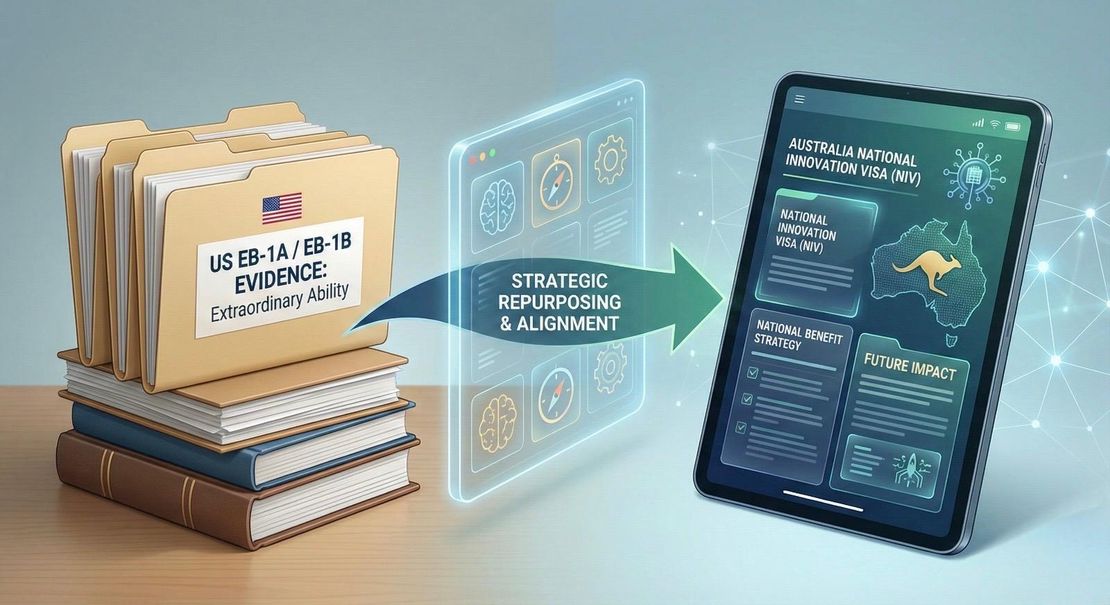
When I examined the evidence they were assembling for their EB-1A, EB-1B, and O-1 applications, I was struck by how familiar it looked compared to what Australia requires for the National Innovation Visa (NIV).
But here’s what you need to understand:
It’s not a simple cut-paste job.
Yes. Your EB package can give you a significant head start. No. You can’t just relabel the folder “Australia” and submit.
Australia’s NIV has its own logic, its own pathways, and several “non-negotiables” that the US process doesn’t require you to articulate.
Let’s break down what’s similar, what’s different, and how to repurpose your EB or O-1 file into an NIV-ready portfolio.
Why US Talent Visa Holders Are Looking at Australia Right Now
Before diving into the strategy, let’s acknowledge why this conversation is happening more frequently in 2025-26.
The EB-1 Backlog Reality
If you’re an Indian national pursuing EB-1A or EB-1B, the numbers are sobering:
- Current EB-1 India priority date: March 2022 (as of December 2025)
- Estimated wait time: 34 to 46 months beyond I-140 approval
- Pending applications: Approximately 16,800 in the EB-1 queue for India alone
Even with premium processing for the I-140 petition (15 business days for $2,805), the actual green card can take 2-4 years after approval due to per-country visa limits.
Chinese nationals face similar challenges, with wait times of 26 to 38 months.
The O-1 Limitations
The O-1 visa offers faster processing—around 2.5 months, or 15 days with premium processing. But it comes with structural limitations:
- Requires employer sponsorship (no self-petition)
- Temporary status with renewals every 1-3 years
- No direct path to permanent residency
- New $250 visa integrity fee as of 2025
For those seeking stability and a permanent home, the O-1 is a stepping stone, not a destination.
What Australia Offers Differently
The National Innovation Visa provides:
- Permanent residency from day one
- No employer sponsorship required
- No per-country quotas or backlogs
- Path to citizenship in 4 years
- Freedom to change jobs or start a business immediately
Processing times for NIV currently run 4-6 months to visa decision—potentially faster than an EB-1 green card for all nationalities, including Indian or Chinese nationals.
What EB-1A, EB-1B, and O-1 Applicants Already Have (The Good News)
Most EB-1A, EB-1B, and O-1 applicants are already assembling evidence around:
- Recognition: Awards, honours, competitive grants
- Leadership and influence: Reviewing, judging, committee roles, advisory positions
- Credibility: Memberships, affiliations, invited presentations
- Impact: Citations, patents, implementations, revenue, clinical outcomes
- Visibility: Press coverage, media mentions, profiles, interviews
- Output: Publications, products, open-source contributions, policy work
If you’ve been building an EB case, you’re accustomed to thinking in an evidence-first way. That mindset is gold for NIV.
Because NIV, like EB-1 pathways, is heavily evidence-driven. It rewards a clear track record, not vague potential.
Why NIV Feels Similar to EB-1A and EB-1B
Strip away the country-specific terminology, and both systems are answering a similar question:
“Are you demonstrably exceptional in your field, and can you prove it?”
That’s why there’s substantial overlap in the types of documents that matter.
Evidence That Often Transfers Cleanly from EB-1 to NIV
Think of these as your “easy wins”:
1. Awards and Recognition
- Major field-wide awards
- Competitive institutional, national, or industry awards
- Named fellowships or honours
2. National Level Grants, Publications, Citations, and Academic Influence
- National Government grants
- High-quality publications in peer-reviewed journals
- Strong citation profile relative to field and career stage
- Evidence that others rely on your work (guidelines, standards, methods)
3. Peer Review and Judging
- Journal manuscript reviewing
- Grant panel participation
- Conference program committee roles
- Awards judging
4. Published Material About You
- Media coverage
- Profiles and interviews
- Substantial institutional press releases
5. Original Contributions
- Patents and commercialisation
- Methods or tools adopted by others
- Documented outcomes in health, technology, climate, security, or productivity
6. Leading or Critical Roles
- Key role in a startup, lab, program, product, or initiative
- Evidence the organisation is respected and your role was significant
If you’re reading this and thinking, “That’s basically my EB evidence list,” you’re not imagining it.
But Here’s the Catch: NIV Isn’t “EB-1 With Kangaroos”
This is where applicants can get burned.
The evidence may overlap, but the story you’re telling is fundamentally different.
The Biggest Mindset Shift
US EB pathways emphasise: “I meet these criteria because I’m extraordinary or outstanding.”
Australia’s NIV wants that too—but it also wants: “My work aligns with Australia’s national priorities, and I will create measurable benefit here.”
So the NIV version of your story needs an additional layer:
- Why Australia (not just “anywhere but the US”)
- Why now (what makes this the right moment)
- Why your work matters to Australia specifically
- Where you will contribute (state, sector, ecosystem)
- How your impact will manifest in Australia
That’s not window dressing. It’s one of the main reasons copy-paste applications underperform.
Key Differences Between EB-1A/EB-1B and NIV
1. NIV Is Invitation-Based
With NIV, you don’t simply apply. You lodge an Expression of Interest (EOI) and wait for an invitation. Strategy matters enormously:
- How you position your profile
- What evidence you front-load
- How clearly you match what Australia is prioritising
The Department processes applications in a four-tier priority system:
Priority 1: International specialists and leaders (Nobel Prize recipients, etc.) Priority 2: Nominees of Australian Federal or State Government agencies Priority 3: Exceptional candidates in Tier One sectors (Critical Technologies, Health Industries, Renewables) Priority 4: Outstanding achievers in Tier Two sectors
Even very strong candidates can underperform if the narrative is unclear.
2. NIV Has a “Priority + National Benefit” Flavour
EB-1 can be very criteria-checkbox oriented. NIV is more holistic:
Show us you’re exceptional and show us why Australia benefits.
You need a clearer “impact pathway” than most EB applicants are accustomed to articulating.
3. The Structure and Packaging Expectations Differ
An EB file is often built like a legal brief, especially with attorney support. NIV tends to reward:
- Clearer plain-English framing
- Stronger front-page summaries
- Evidence organised around impact + recognition + leadership rather than criteria numbers
Same documents. Different assembly.
4. Nomination and Ecosystem Alignment Matter
For NIV, the nomination angle and where you sit in the Australian ecosystem can be a significant part of your credibility story—especially for near-term impact in priority sectors.
EB-1B, by contrast, is typically tied more directly to an employer or institutional context in the US.
5. EB-1B Translation for Researchers
If you’re pursuing EB-1B (Outstanding Professor/Researcher), you likely have strong “institutional validation” evidence—employment at a prestigious institution, lab leadership, funded research, international collaborations.
For NIV, you’ll want to translate that into:
- Australian collaborations (existing or planned)
- Sector relevance to NIV priority areas
- National benefit pathways (commercialisation, health outcomes, critical technology development)
How to Repurpose an EB File into an NIV-Ready Portfolio
Here’s a practical framework that doesn’t require reinventing the wheel.
Step 1: Keep Your EB Evidence; But Reorganise It
Instead of “EB-1 criteria 1–10,” rebuild your folder into NIV-friendly categories:
- International Recognition & Awards
- Current Prominence (recent speaking, judging, reviewing, invitations)
- Impact (adoption, outcomes, citations, patents, revenue)
- Leadership & Critical Roles
- Media & Visibility
- Australia Benefit Strategy (the piece you’re missing)
You’re not changing the substance; just making it easier for the NIV assessor to understand quickly.
Step 2: Write the Australia Benefit Plan
This is where you transform “I’m exceptional” into “I’m exceptional and here’s how Australia benefits.”
A strong plan addresses:
- What problem are you solving?
- Why does it matter to Australia?
- What sector or ecosystem will you contribute to?
- What will you accomplish in the first 6–12 months?
- What tangible outcomes could exist in 2–3 years?
For founders: Jobs created, exports, investment attracted, productivity gains, IP development, capability building
For researchers: Translation pathways, industry partnerships, clinical outcomes, national capability development
Step 3: Replace Legal Brief Tone with Executive Summary Clarity
This is subtle but powerful.
EB files can be very lawyerly. NIV tends to perform better when it’s:
- Crisp and direct
- Evidence-forward
- Written like a smart executive summary
Not less rigorous—just more readable.
Step 4: Identify Your Gaps Early
Common gaps for EB applicants transitioning to NIV:
- Insufficient Australia-specific linkage
- Not enough independent recognition (everything is internal to your employer)
- Impact not quantified
- Evidence is strong but narrative is scattered
Fixing gaps before lodging is the difference between “promising” and “invite-worthy.”
Who This Works Best For
The EB-1/O-1 to NIV pathway is especially strong for:
- Researchers with competitive grants and strong citation impact
- Founders with real traction (funding, revenue, patents, significant partnerships)
- Professionals with strong intellectual property and documented recognition outside their employer
- Hybrid profiles combining research with commercialisation
If you’re earlier-stage and still building recognition, you can still plan for NIV, but the strategy focuses on building the evidence pipeline over the next 6–18 months.
The O-1 to NIV Pathway
For current O-1 holders specifically, the NIV offers what the O-1 cannot:
| O-1 Visa | National Innovation Visa |
|---|---|
| Temporary status | Permanent residency |
| Employer-sponsored | Self-petition allowed |
| Renewals every 1-3 years | One-time grant |
| No direct green card path | Path to citizenship in 4 years |
| US work only | Full work rights in Australia |
If your O-1 evidence meets the “extraordinary ability” threshold, much of it will be relevant for NIV—with the Australia benefit layer added.
The Bottom Line
If you’re preparing an EB-1A, EB-1B, or O-1 case, your application probably is close to NIV-ready in one important sense:
You already have the hardest part—the proof.
What you need is:
- The NIV structure and framing
- The Australia benefit layer
- A strategy that fits how NIV invitations actually work
For those facing multi-year EB backlogs or O-1 renewal uncertainty, Australia offers an alternative that doesn’t require starting from scratch—but does require thinking differently about how you present your achievements.
How Wisekangaroo Can Help
At Wisekangaroo, we’ve helped numerous US-based professionals translate their EB and O-1 evidence packages into successful NIV applications.
We can help you:
- Assess your current evidence against NIV requirements
- Identify gaps and strengthen weak areas
- Develop your Australia benefit narrative
- Connect you with Australian nominators in your sector
- Navigate the EOI and invitation process
Many of our clients have been surprised at how much of their EB work transfers—and how different the final NIV package looks once properly structured for Australia.
Ready to Explore Your Options?
Book a consultation today and let’s assess how your EB-1 or O-1 evidence might translate to Australia’s National Innovation Visa.
Frequently Asked Questions
Q: Can I apply for NIV while my EB-1 case is pending?
A: Yes. The NIV and US immigration processes are entirely separate. Many applicants pursue both simultaneously as a hedge against EB backlogs or potential policy changes.
Q: Do I need to be in Australia to apply for NIV?
A: No. You can lodge an EOI and apply from anywhere in the world. You can be in Australia (or offshore, depending on your situation) when the visa is granted.
Q: What if I don’t have Australian connections or a nominator?
A: We can help identify appropriate nominators in your sector. Australian universities, research institutions, industry bodies, and successful Australian citizens or PRs can all serve as nominators for NIV applicants.
Q: How does NIV compare to EB-1A approval rates?
A: NIV is highly competitive. Recent data shows approximately 3%-6% of EOIs receive invitations. However, for candidates who would qualify for EB-1A, the evidence threshold is comparable. The difference is in how you present it.
Q: What English level do I need for NIV?
A: NIV requires Functional English, which is a lower threshold than many other Australian skilled visas. Most EB-1/O-1 candidates meet this requirement easily.
Last updated: December 2025. Information current as of publication date. Always check the official Department of Home Affairs for latest requirements.
This article is for general information only. For specific advice about your circumstances, consult a registered migration agent.