
Checked 28 October 2026, Sydney time.
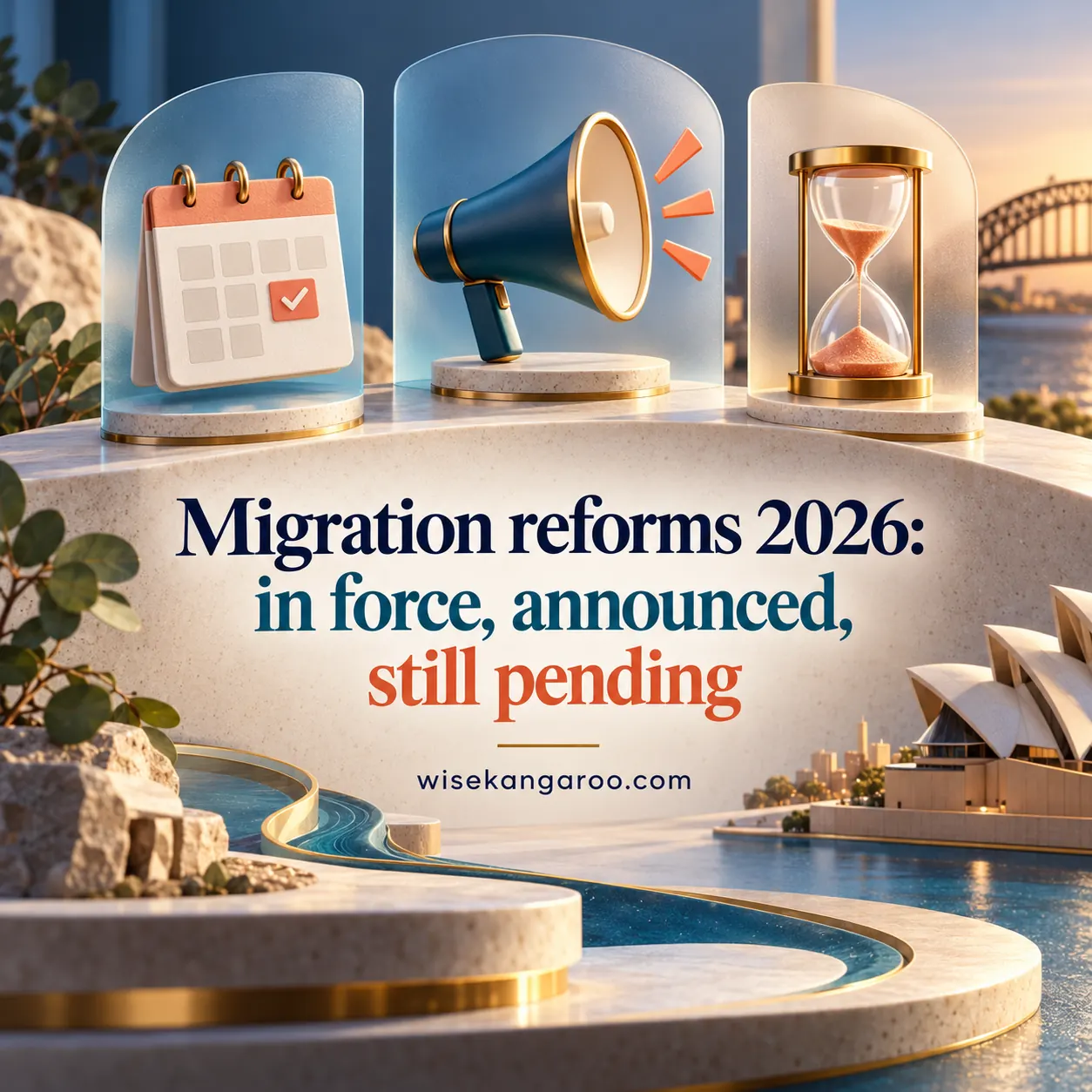
Migration reforms 2026 span measures already operating and plans still being rolled out. The useful question is which rule applies to your next step, rather than whether a change appeared in a headline.
This dated tracker focuses on National Innovation visas, Partner visas, skilled migration and employer sponsorship. It brings together the relevant status checks and links to our detailed guides.
What is operating now?
Home Affairs confirms that Directions 121 and 122 replaced Direction 119 on 19 September 2026. NIV and Family visa processing have separate directions which were already operating before the September announcement.
| Pathway or setting | Status on 28 October 2026 | What to check next |
|---|---|---|
| Subclass 482 processing, Direction 121 | In force since 19 September 2026. Covers the specified temporary skilled applications. | Check the occupation, stream and other priority conditions in our Direction 121 guide. |
| Specified provisional and permanent skilled visas, Direction 122 | In force since 19 September 2026. Includes relevant 186, 189, 190, 491 and 494 applications, among others. | Use the Direction 122 checklist for the covered subclasses, exclusions and family rules. |
| NIV visa processing and assessment, Direction 120 | Existing framework, in force since 25 July 2026. This is separate from the September replacement of Direction 119. | Read our NIV priorities guide and distinguish the EOI invitation stage from the visa application. |
| Partner and other Family visa processing, Direction 117 | Existing framework, replacing Direction 102 on 25 July 2026. | Check Home Affairs’ Family priorities, your application circumstances and the visa’s grant-location requirements. |
Processing priority does not establish that an application meets the visa requirements or promise a decision date. The detailed guides explain the rules without treating every skilled visa as the same pathway.
NIV and Partner applicants: keep the right checks in view
The NIV remains an invitation-only permanent visa. An EOI asks to be considered for an invitation; it is not the visa application. A proposed change to skilled points should not be treated as a new entitlement to an NIV invitation.
The practical work is to prepare evidence of your achievements against the current framework. Our NIV services explain the support available with that preparation.
For Partner applicants, Direction 117 gives higher priority to applications made while the primary applicant was in Australia for a visa that can be granted in Australia. That does not make an onshore application available to every visiting partner. Check the current visa, conditions and eligibility before choosing when or where to apply. Our 820/801 evidence guide addresses the separate relationship-evidence task.
Announced: what is still pending?
The 17 September Ministerial speech announced a package of measures. Home Affairs says implementation is progressive over the following 12 months. That rollout statement is not a start date for every item.
| Announced measure | Status established in this check | Practical implication |
|---|---|---|
| Housing-trade uplift in the redesigned skilled points test | Announced; not implemented in the current points table. Schedule 6D still awards 10 education points for an Australian trade qualification and 15 for a bachelor qualification. | Use the current points rules for your qualifications; do not add the announced uplift to your calculation. |
| No Further Stay restrictions across future visitor visas | Announced; the universal rollout date and coverage remain unconfirmed. | Do not infer the conditions on a particular visa from the announcement. Read its grant notice and check VEVO before planning an onshore application. |
Existing No Further Stay conditions already matter. Home Affairs’ waiver guidance explains that a waiver request does not remove the condition or extend your lawful stay. Our 8503 guide covers the separate problem of a pending application and an onshore grant.
Before changing your plans
- Identify the visa or nomination pathway and the step you are about to take.
- Check the operative source, its commencement date and any transitional provisions.
- Compare those rules with your grant conditions, application history and evidence.
- Keep state nomination changes separate from federal rules. Victoria’s ranking system, for example, is covered in our Victorian nomination guide.
If you would like help checking how a change affects your next step, contact WiseKangaroo with your visa details, relevant correspondence and intended dates. For an already prepared file, ask whether our application review service covers the questions you need checked.
Frequently asked questions
Does an announcement mean a rule applies immediately?
Check the operative rule, commencement date and who it covers. A speech or policy announcement alone does not establish that every measure has started.
Does the same priority direction cover NIV and employer-sponsored visas?
No. Direction 120 covers the relevant subclass 858 framework; Directions 121 and 122 cover specified temporary and provisional or permanent skilled visas. Check the correct pathway.
Can a visiting partner rely on an announced reform to apply onshore?
Check the current visa conditions and Partner visa requirements first. Existing No Further Stay conditions can already restrict onshore options; an announcement is not permission to lodge.
General information, checked on 28 October 2026. This tracker covers selected measures and existing settings, not an individual eligibility assessment. Recheck current requirements before acting.