
Last updated: April 2026. Based on Department of Home Affairs current invitation round data. Figures current as of publication date.
National Innovation Visa: Q4 2025 Peak and the Jan-Mar 2026 Pullback
The Department of Home Affairs has now published two more rounds of National Innovation Visa (NIV) data since our Q3 2025 analysis, and the shape of the program has changed.
Q4 2025 (Oct-Dec) was the program’s peak. 226 invitations were issued from 2,368 Expressions of Interest, a 9.5% hit rate.
Q1 2026 (Jan-Mar) was the first quarter-on-quarter decline. 146 invitations from 1,815 EOIs, an 8.0% hit rate. Both the EOI volume and the invitation count fell.
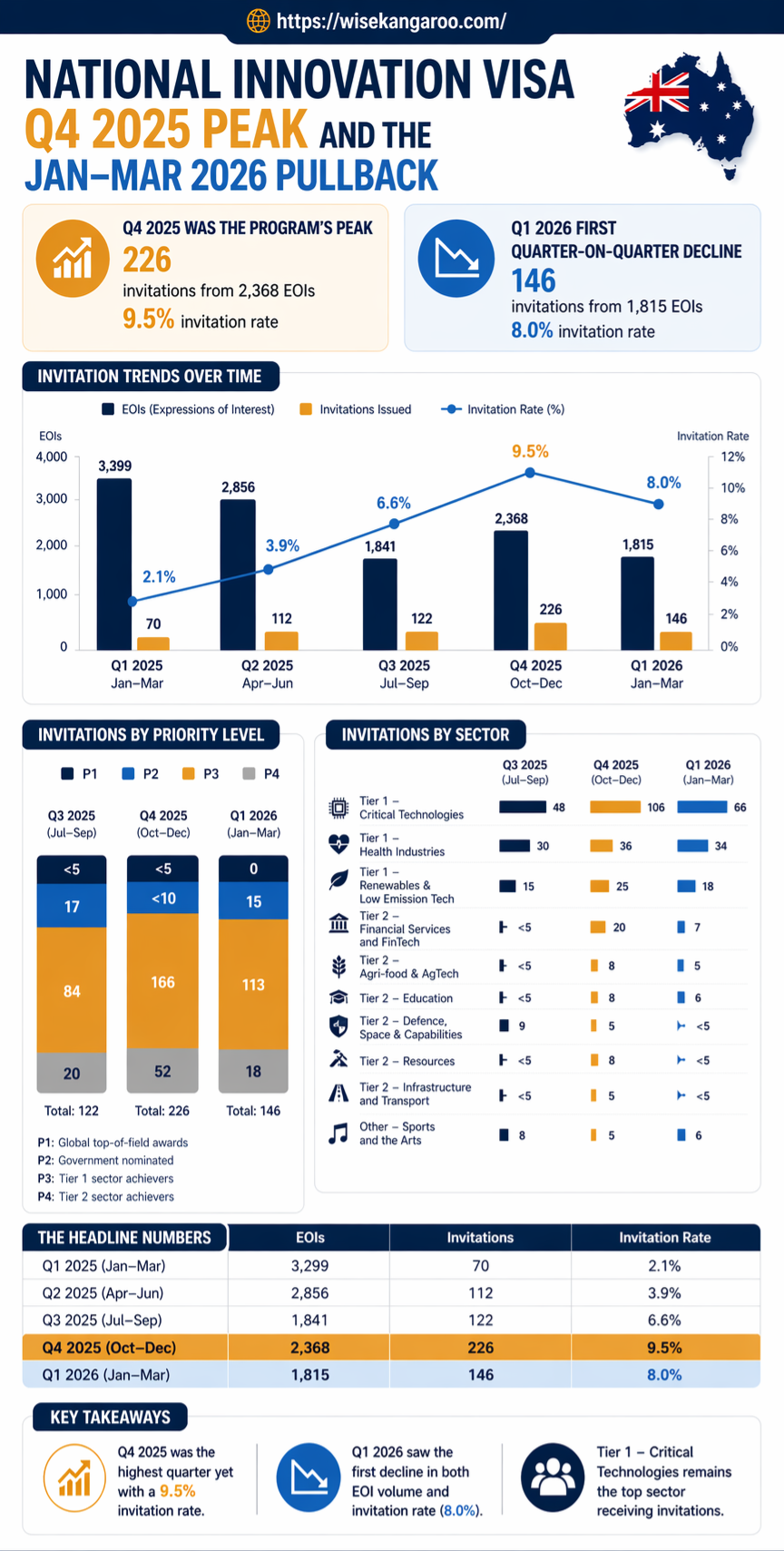
The Headline Numbers
| Quarter | EOIs | Invitations | Invitation Rate |
|---|---|---|---|
| Q1 2025 (Jan-Mar) | 3,299 | 70 | 2.1% |
| Q2 2025 (Apr-Jun) | 2,856 | 112 | 3.9% |
| Q3 2025 (Jul-Sep) | 1,841 | 122 | 6.6% |
| Q4 2025 (Oct-Dec) | 2,368 | 226 | 9.5% |
| Q1 2026 (Jan-Mar) | 1,815 | 146 | 8.0% |
For four consecutive quarters from launch, the invitation rate climbed. Q1 2026 is the first period where it has fallen.
Invitations by Priority Level
| Priority | Q3 2025 | Q4 2025 | Q1 2026 |
|---|---|---|---|
| P1 (global top-of-field awards) | <5 | <5 | 0 |
| P2 (government nominated) | 17 | <10 | 15 |
| P3 (Tier 1 sector achievers) | 84 | 166 | 113 |
| P4 (Tier 2 sector achievers) | 20 | 52 | 18 |
Invitations by Sector
| Sector | Q3 2025 | Q4 2025 | Q1 2026 |
|---|---|---|---|
| Tier 1 – Critical Technologies | 48 | 106 | 66 |
| Tier 1 – Health Industries | 30 | 36 | 34 |
| Tier 1 – Renewables & Low Emission Tech | 15 | 25 | 18 |
| Tier 2 – Financial Services and FinTech | <5 | 20 | 7 |
| Tier 2 – Agri-food and AgTech | <5 | 8 | 5 |
| Tier 2 – Education | <5 | 8 | 6 |
| Tier 2 – Defence, Space and Capabilities | 9 | 5 | <5 |
| Tier 2 – Resources | <5 | 8 | <5 |
| Tier 2 – Infrastructure and Transport | <5 | 5 | <5 |
| Other – Sports and the Arts | 8 (in Tier 2) | 5 (in Other) | 6 (in Other) |
Six Insights That Are Not Obvious From the Headlines
1. Q4 2025 was the program’s peak, not a trend point
Between launch and Q4 2025, every quarter was stronger than the last. The invitation rate climbed from 2.1% to 9.5%. Then Q1 2026 broke the line. Both EOI volume (down 23%) and invitations issued (down 35%) pulled back.
2. The pullback was concentrated in Tier 2
Priority 3 (Tier 1 achievers) fell from 166 to 113, a 32% drop. Priority 4 (Tier 2 achievers) fell from 52 to 18, a 65% drop. Tier 2 bore more than twice the proportionate drop.
The practical consequence is that the gap between Tier 1 and Tier 2 widened this quarter.
3. Financial Services and FinTech had a Q4 2025 spike that did not carry
FinTech was barely visible in Q3 2025. In Q4 2025 it jumped to 20 invitations, the largest Tier 2 sector for that quarter and on par with some Tier 1 sectors. In Q1 2026 it fell back to 7.
A one-quarter burst like that is usually driven by a cohort of comparable profiles applying at roughly the same time, or a targeted government nomination wave, rather than a structural shift in sector priority. Do not read the Q4 FinTech spike as a permanent reweighting of Tier 2. Plan against the three-quarter average.
4. Critical Technologies is now structurally dominant
Critical Technologies has accounted for 39%, 47% and 45% of total invitations across the last three quarters. Three consecutive quarters at or near half of all invitations is no longer a trend, it is the structure of the program.
Critical Technologies is broad by design. It covers AI and machine learning, quantum, advanced manufacturing and robotics, cyber, advanced materials, space technologies, and biotech. If you are positioned in a Tier 2 sector but your actual work sits inside one of these subfields, re-examine your EOI sector. Our NIV priority pathways guide sets out the definitions in detail.
5. Priority 1 and Priority 2 are not the growth engine
- Priority 1 has produced fewer than 5 invitations in each of the last three quarters, and zero in Q1 2026. In operational terms, it is close to a theoretical pathway. It is not evidence of the Department tightening criteria. It reflects how narrow the international “top of field” bar is in practice.
- Priority 2 has come in at 17, under 10, and 15 across the last three quarters. Stable, flat, and small. Despite significant public activity around state and territory nomination programs through 2025 and early 2026 (covered in our state nomination comparison), the government nomination volume has not scaled.
Almost all of the program volume sits in Priority 3. That is where your planning effort should sit too.
6. EOI volume is cyclical, not steady
EOI submissions have gone 1,841 → 2,368 → 1,815 across the last three quarters. That is a ±20% quarterly swing. The applicant pool has not settled into a steady-state volume.
What that means in practice is that a big quarter like Q4 2025 tends to be a partial preview of a smaller follow-up quarter, as applications cluster and then drain. If you are timing a fresh EOI, do not treat the current quarter’s invitation rate as a guaranteed floor for next quarter. It has moved down once already.
Also worth noting: Sports and the Arts moved from Tier 2 to a standalone “Other” row in Q4 2025, not Q1 2026.
What This Means If You Are Considering the NIV
If you work in Critical Technologies, Health Industries, or Renewables, the overall direction is still favourable, but Q4 2025 likely represented the ceiling rather than the new normal. Build your evidence base as if the hit rate is closer to 8% than 9.5%.
If your profile sits in Tier 2, Q1 2026 is a warning. A 65% quarter-on-quarter drop in Priority 4 invitations suggests Tier 2 gets whatever capacity remains after Tier 1 is served. If there is a defensible repositioning into Critical Technologies, Health, or Renewables, it is worth the work. If there is not, expect longer waits and plan accordingly.
If you are pursuing a state or federal government nomination (Priority 2), keep the conversation going, but do not rely on it as the primary path. The P2 pipeline has held flat across three quarters of increasing total invitations. Treat it as a supplement, not a substitute.
If you are holding an older EOI, remember that an EOI cannot be edited after submission. If your achievements have moved forward, by way of new awards, publications, patents, funding, or media coverage, lodge a fresh EOI so the stronger evidence sits on file for the next round.
Get Advice Before You Submit
The NIV bar is high, and the margin between an invited profile and a pass is often presentational rather than substantive. If you have questions about your Tier 1 positioning, your nominator strategy, or the evidence base you should be building between now and the next round, get in touch and we will walk you through where you sit relative to the current data.
You may also find these related guides useful:
- NIV Q3 2025 Invitation Trends
- NIV Priority Pathways Explained
- NIV for Academic Researchers: Evidence Guide
- Fast NIV Invitations for Tech Founders
- NIV State Nomination Comparison: NSW, VIC, SA, QLD
This article is for general information only and is current as of 23 April 2026. It is not legal advice. For advice specific to your circumstances, consult a Registered Migration Agent. Always verify current NIV invitation data with the Department of Home Affairs.