
Australia’s National Innovation Visa (NIV, subclass 858) is the country’s flagship permanent residence pathway for exceptional talent. It replaced the Global Talent Visa on 7 December 2024, tightened eligibility under Ministerial Direction 112, and introduced a structured four-tier priority framework that fundamentally changes how you should plan your application.
Here’s what most applicants don’t grasp early enough: the NIV is an invitation-only visa. You can’t simply lodge a visa application. You must first submit an Expression of Interest (EOI) to the Department of Home Affairs, and the Department decides, based on the priority framework, whether to invite you. Your EOI stays active for two years. If invited, you have exactly 60 days to lodge your full visa application. Miss that window and you’re back to square one with a fresh EOI.
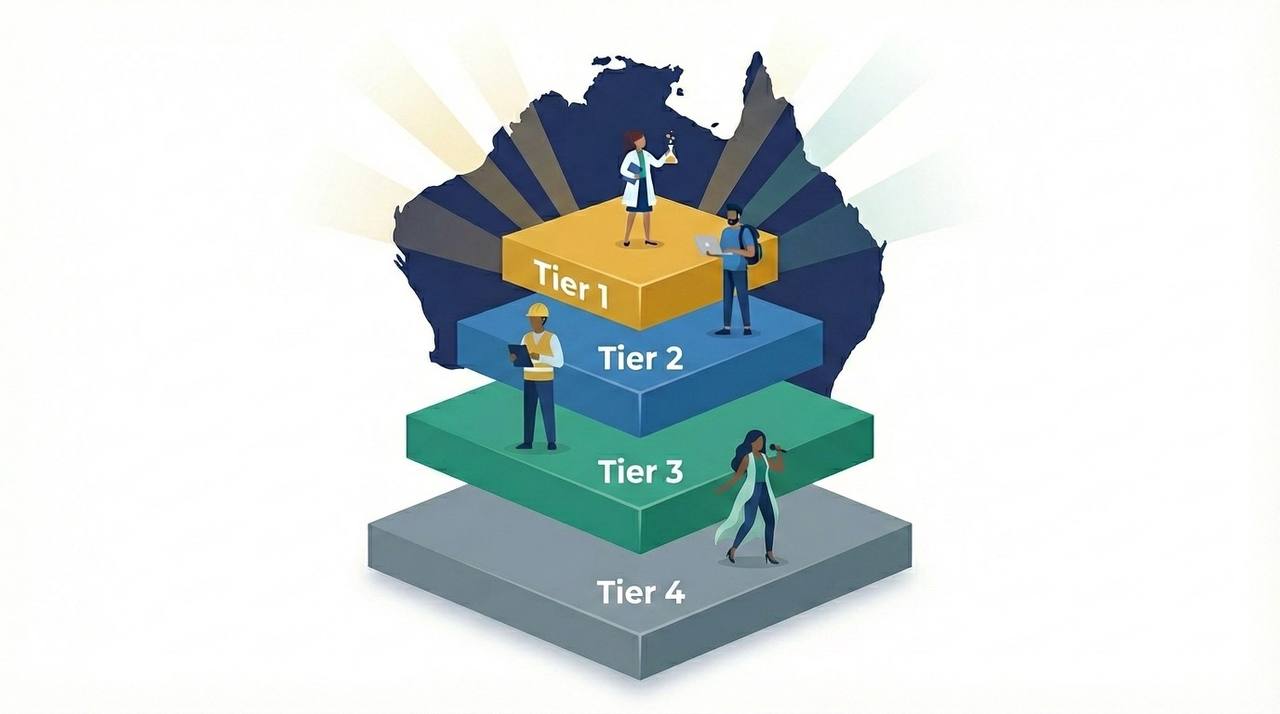
The priority framework isn’t administrative fine print. It determines whether you receive an invitation in weeks, months, or never. Priority 1 and 2 candidates are invited as soon as they are identified. Priority 3 and 4 candidates wait for monthly invitation rounds, and with over 9,000 EOIs submitted since launch and only around 300 invitations issued, the maths is brutal: roughly a 3.4% invitation rate.
This post breaks down all four NIV priority tiers with the level of specificity that actually matters for 2026 applicants.
How the NIV Process Actually Works
Before diving into the priority tiers, it helps to understand the two-stage process every NIV applicant must navigate. The old Global Talent “lodge and wait” model no longer applies.
Stage 1: Expression of Interest (EOI). You submit an EOI through ImmiAccount, outlining your achievements, sector alignment, and nomination details. This is free and is not a visa application. Critically, your EOI cannot be updated after submission: what you lodge is what gets assessed. The Department reviews EOIs against the priority framework and indicators of exceptional and outstanding achievement set out in Ministerial Direction 112.
Stage 2: Visa Application. If invited, you have 60 days to lodge your full visa application (Form 858) with all supporting evidence, health checks, character certificates, and nomination (Form 1000).
The priority framework governs Stage 1: who gets invited, and how quickly. Let’s walk through each tier.
Priority 1: Top-of-Field International Awards
What It Is
Priority 1 is reserved for individuals who hold internationally recognised “top of field” awards: Nobel Prize, Fields Medal, Turing Award, Pulitzer Prize, Olympic Gold Medal, Academy Award, Booker Prize, Pritzker Prize, and equivalents. This tier is sector-agnostic: it doesn’t matter which industry you’re in. If your award places you at the absolute pinnacle of your discipline globally, you’re Priority 1.
Who Qualifies
The key test isn’t whether you’ve won “an” award. It’s whether the award itself carries sufficient international prestige that it effectively speaks for itself. Regional or national-level awards won’t qualify, regardless of how competitive they are domestically.
Invitation Timing
Priority 1 candidates are invited to apply as soon as they are identified by the Department. No monthly rounds. Once your EOI is assessed and your award verified, the invitation follows promptly.
A Practical Note
If you need to ask whether you qualify for Priority 1, you almost certainly don’t. This tier exists for a very narrow cohort of globally pre-eminent individuals. For the other 99.9% of exceptional applicants, the real strategic decisions sit in Priorities 2 through 4.
Priority 2: Government Agency Nomination
What It Is
Priority 2 applies when you are nominated by an expert Australian Commonwealth, State, or Territory Government agency using the approved Form 1000. This is the tier most serious NIV applicants should be targeting: the sweet spot between accessibility and processing speed.
This isn’t limited to state governments. Commonwealth agencies can nominate too. The common thread is that a government body with relevant expertise formally endorses your exceptional talent and alignment with Australia’s innovation priorities.
Which States Are Currently Nominating?
As of early 2026, the state-level programs with publicly available NIV nomination frameworks include:
| State/Territory | Status | Model | Notes |
|---|---|---|---|
| New South Wales | Open (since July 2025) | 5 pathways: Researchers, Entrepreneurs, Investors, Sports, Creatives | ROI-based; holistic review by domain experts |
| Victoria | Open (since July 2025) | Referral-based | Must engage with Victorian Government department first |
| South Australia | Open | ROI applications across 5 categories | Strong emphasis on commitment to SA-based activity |
| Northern Territory | Open (referral only) | Referral through MigrationNT | Must be referred by eligible NT-based organisation |
| Queensland | Evaluating | Not yet accepting nominations | Program design in progress as of late 2025 |
| ACT | Finalising | Not yet accepting nominations | Procedures being developed |
State program statuses change frequently. Always verify directly with the relevant migration body before committing to a nomination pathway. For a deeper dive, see our state nomination comparison.
Why Priority 2 Matters
Invited as soon as identified (like Priority 1, no monthly round delays). This is a material advantage over Priority 3 and 4.
Government endorsement carries weight. A state or Commonwealth nomination signals to the case officer that expert vetting has already occurred. It doesn’t replace your evidence, but it frames the entire assessment favourably.
Multiple nomination pathways. With several jurisdictions now running programs, there are genuine options to match your profile to a state’s strategic priorities. See the current state and territory nomination allocations to understand where capacity sits.
The Trade-Off
The official Priority 2 processing advantage doesn’t account for the weeks or months it takes to secure the state nomination itself. ROI-to-nomination timelines vary significantly between jurisdictions, and geographic alignment matters. States nominate talent that serves their economic strategy. If your field doesn’t match their current priorities, your ROI won’t be selected even if you’d be competitive nationally.
Priority 3: Exceptional Achievement in Tier One Sectors
What It Is
Priority 3 is for applicants with exceptional and outstanding achievements in the NIV’s designated Tier One sectors, the areas the Australian Government has identified as highest priority for innovation:
- Critical Technologies: AI, advanced robotics, cybersecurity, quantum technologies, and other transformative enabling technologies
- Health Industries: Medical manufacturing, sovereign capabilities in medical science, implantable and wearable devices, regenerative medicine
- Renewables and Low Emission Technologies: Technology supporting the net-zero transition, including clean hydrogen, waste-to-energy, and sustainable energy systems
If your achievements fall squarely within one of these three sectors, and you don’t have a top-of-field award (P1) or government nomination (P2), this is your pathway.
The Form 1000 Requirement
Every NIV applicant, regardless of priority tier, needs a nominator who completes Form 1000. For Priority 3, your nominator is an individual or organisation rather than a government agency. This could be a professor at a Group of Eight university, a senior figure at CSIRO, the CEO of a relevant industry body, or similar. The nominator must be an Australian citizen, permanent resident, eligible New Zealand citizen, or an Australian organisation with a national reputation in your field.
The distinction matters: without a government agency endorsement, your evidence portfolio carries more of the weight. Choosing the right nominator is one of the highest-leverage decisions in your application.
Evidence That Moves the Needle
Ministerial Direction 112 provides guidance on what constitutes exceptional and outstanding achievement. The indicators vary by profile:
Researchers: Publications in top-tier international journals, high citation counts and h-index benchmarked against field norms, national or international research grants (ARC grants, equivalent international funding), keynote appearances at flagship conferences, patents and IP. (See our evidence guide for academic researchers.) For a real-world example, read our NIV success story: health researcher.
Entrepreneurs: Successful ventures with independently verifiable commercial traction, patents in the relevant Tier One sector, evidence of products or services reaching market, demonstrable economic impact. See how a HealthTech entrepreneur secured an NIV grant as a worked example.
Technology Professionals: Patents, technical publications, product documentation showing adoption at scale, press coverage in international outlets of record.
For all applicants: Two strong, genuinely independent reference letters from internationally recognised figures in your field will consistently outperform five weaker ones. A reference from your direct supervisor carries almost no independent weight, as case officers are trained to assess true independence and authority.
Invitation Timing
Priority 3 candidates are invited in monthly rounds, not as soon as identified. In competitive months, your EOI may not be selected even if strong. Processing timelines from EOI to visa decision are likely in the mid-to-longer range.
Priority 4: Exceptional Achievement in Tier Two Sectors
What It Is
Priority 4 covers applicants with exceptional achievements in the NIV’s Tier Two sectors:
- Agri-food and AgTech: Precision agriculture, gene editing, predictive farming technologies, wearable tech for animal management
- Defence Capabilities and Space: Rocket technology, space situational awareness, high-tech materials, quantum communications, space medicine
- Education: Academia, research, or senior management in universities and higher learning institutions
- Financial Services and FinTech: Digital payments, blockchain applications, regulatory technology
- Infrastructure and Transport: Innovative manufacturing supporting transport, large and complex infrastructure projects
- Resources: Innovation in resource sectors or critical minerals supply chains, mineral processing technologies
Invitation and Processing
Like Priority 3, Priority 4 candidates are invited in monthly rounds. Given Tier Two sits below Tier One in the priority ordering, invitations for Priority 4 EOIs are issued after P1, P2, and P3 candidates have been considered, meaning longer waits and higher competition for available slots. Our Q3 2025 invitation trends analysis breaks down the numbers in detail.
The Strategic Question
If your achievements sit in a Tier Two sector, the most important question is: can you secure a government agency nomination to move into Priority 2? A strong candidate in Education or Resources who obtains a state nomination moves from monthly rounds to immediate invitation consideration. That shift alone can compress your timeline by months.
This is exactly the kind of strategic assessment a registered migration agent should be helping you with before you lodge your EOI. Contact us to get a clear read on your position.
The Case Officer’s View
Here’s what practitioners consistently observe about how NIV applications are actually assessed:
The “no edit” rule has strategic consequences. Your EOI is locked the moment you submit. Lodge too early with a thin profile and you’re stuck for two years. Wait until you have stronger evidence (a major publication, a patent grant, a significant award) and your EOI is materially stronger. Timing your submission is a genuine strategic decision, not an afterthought.
Evidence scrutiny varies by pathway. The legal standard is the same across all tiers (“exceptional and outstanding achievement”), but in practice, Priority 2 applicants benefit from the independent institutional validation that a government nomination provides. Priority 3 and 4 applicants must be demonstrably excellent on paper alone. Every claim needs robust, independently verifiable evidence. Our state nomination comparison outlines what each jurisdiction looks for.
Cross-sector profiles need careful framing. What if you’re a FinTech health data researcher who spans Health Industries (Tier One) and Financial Services (Tier Two)? The answer depends on how you frame your EOI. Lead with the sector where your strongest evidence sits, and make the alignment explicit. An EOI that straddles two sectors without committing to either gives the case officer a reason to defer.
Programme selectivity is real. With approximately 9,000 EOIs submitted and only around 300 invitations issued, the NIV is running at roughly a 3.4% invitation rate. Of those invited, around 85 visas have been granted (roughly a 28% grant rate from invitation). These numbers underscore why positioning matters: getting your tier, evidence, and framing right isn’t a marginal advantage, it’s the difference between an invitation and two years of silence.
What Every NIV Applicant Needs (Regardless of Priority)
| Requirement | Detail |
|---|---|
| Nomination (Form 1000) | Every applicant needs a nominator. For P2, this is a government agency. For P1/P3/P4, an Australian citizen, permanent resident, eligible NZ citizen, or Australian organisation with national reputation in your field. |
| Exceptional achievement | Assessed against Ministerial Direction 112 indicators. The Department targets the top 0.1% of professionals globally. |
| English proficiency | Functional English minimum (approx. IELTS 4.5 average). If you can’t meet this, pay the second VAC of $5,390. |
| No salary threshold | Unlike employer-sponsored visas, the NIV has no mandatory minimum salary. |
| Age | No strict limit. Applicants under 18 or over 55 must show exceptional, ongoing benefit to Australia. |
| Health & character | Standard health exams and police clearances from every country you’ve lived in 12+ months over the past decade. |
Which Pathway Is Right for You?
Here’s the practical decision framework:
| Your Profile | Recommended Pathway | Why |
|---|---|---|
| Holder of a top-of-field global award (Nobel, Fields Medal, Olympic Gold, Turing, etc.) | Priority 1 | Fastest pathway, sector-agnostic, invited on identification |
| Can secure nomination from an Australian government agency (Commonwealth, State, or Territory) | Priority 2 | Optimal pathway for most competitive applicants. Invited immediately, not batched monthly |
| Exceptional achievements in Critical Technologies, Health Industries, or Renewables, with a strong individual/organisational nominator | Priority 3 | Solid pathway with monthly rounds. Ensure evidence is airtight and nominator is credible |
| Exceptional achievements in Agri-food, Defence & Space, Education, FinTech, Infrastructure, or Resources | Priority 4 | Viable, but seriously consider whether a government nomination could elevate you to P2 first |
The worst outcome we see? Strong candidates defaulting to Priority 3 or 4 because they didn’t know state nomination programs exist or that they could qualify for Priority 2. That assumption costs months of waiting, and sometimes results in never receiving an invitation at all.
Don’t guess. Get a proper assessment.
Frequently Asked Questions
Q: Can I submit an EOI without a nominator?
A: For Priority 2, the government agency nomination (Form 1000) must be included with your EOI. For other priority groups, you can submit your EOI without a completed Form 1000, but you’ll need a nominator for the actual visa application if invited. Having a credible nominator identified early strengthens your positioning significantly.
Q: Do I need a job offer in Australia?
A: No. The NIV is not an employer-sponsored visa. You don’t need an employer to apply, and you’re not tied to a specific employer once granted. This is particularly attractive for researchers and founders. You do need to demonstrate the ability to find employment or establish yourself in your field in Australia.
Q: My sector isn’t on the Tier One or Tier Two lists. Can I still apply?
A: Yes. The priority tiers govern the order in which EOIs are invited; they don’t exclude you entirely. Applicants with exceptional achievements outside the designated sectors can still be considered, though they’ll be prioritised below tiered candidates. With a 3.4% invitation rate, applicants outside the tiered sectors face the longest waits and lowest invitation rates.
Q: What if my field spans both Tier One and Tier Two?
A: Frame your EOI around the sector where your strongest evidence sits. A researcher in health-related FinTech, for example, should lead with Health Industries (Tier One) if their publications and IP are concentrated there. The sector alignment in your EOI determines your priority tier. Make it explicit and defensible.
Q: What happens if my EOI isn’t selected?
A: Your EOI stays active for two years. During that time, the Department may invite you in any monthly round. You cannot update your EOI after submission or add new documents. If it expires without an invitation, you can submit a fresh one. Don’t submit multiple concurrent EOIs unless there’s been a significant change in your circumstances.
Q: Is there a salary threshold for the NIV?
A: No. Unlike some skilled visa subclasses, the NIV has no mandatory minimum salary. However, the “exceptional achievement” standard tends to correlate with professional standing that commands competitive remuneration. Some state nomination pathways reference the Fair Work High Income Threshold as a benchmark, but it’s not a universal NIV requirement.
Q: How does the NIV compare to the old Global Talent Visa?
A: The NIV replaced the GTI on 7 December 2024. Key changes: a formal four-tier priority framework under Ministerial Direction 112, an EOI-then-invitation model (rather than direct application), tighter evidentiary requirements, and a reduced programme allocation of 4,000 places per year (down from 5,000 in 2023-24). Full comparison here.
NIV Lodgement Services
The team at WiseKangaroo has assessed and lodged NIV applications for hundreds of NIV profiles across all four priority tiers. Our eligibility framework identifies which pathway you qualify for, flags evidence gaps before you lodge, and gives you an honest read on whether your profile is ready or needs development.
Start your NIV application journey with wisekangaroo.com →
This guide is for informational purposes only and does not constitute migration advice. Individual circumstances vary. For advice specific to your situation, consult a registered migration agent. WiseKangaroo is a registered Australian migration agency (MARA).