

Last updated: July 2026. Based on the Migration Regulations 1994 (reg 2.59) and current Department of Home Affairs guidance on the Skills in Demand (subclass 482) visa. Figures and processing times current as of publication date.
Standard Business Sponsorship for a Startup: The SBS Guide
Can a brand new company with no employees and no revenue become an approved sponsor? It is one of the most common worries founders bring to us, and the honest answer surprises them: yes, it can. Standard business sponsorship does not require a big payroll, years of trading, or a full profit and loss history. It requires the right evidence and the right strategy.
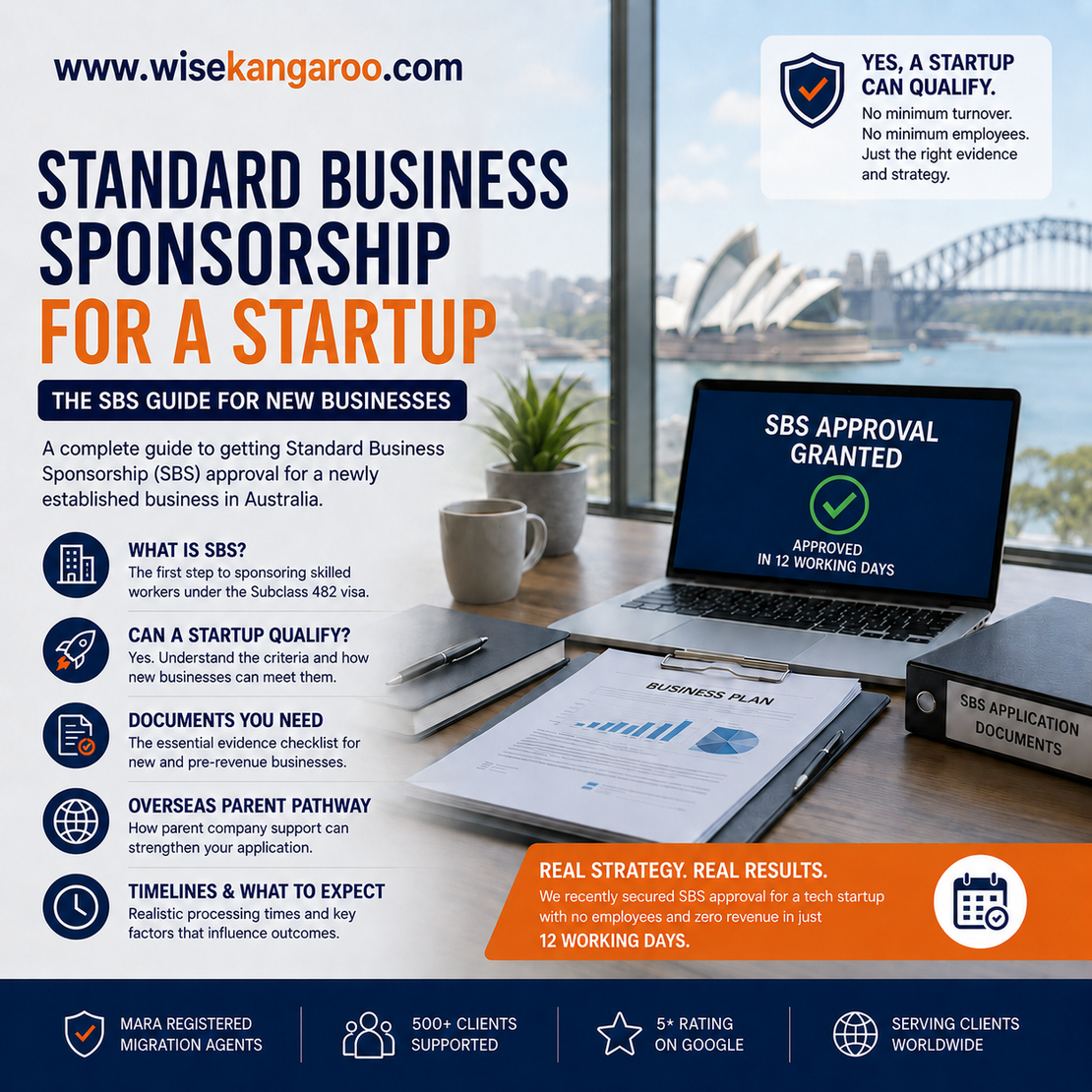
We recently guided a technology startup through exactly this scenario. The Australian entity had been incorporated for less than six months, employed nobody locally, and had booked zero revenue. We still secured its standard business sponsorship approval, and the decision landed in roughly twelve working days.
This guide walks through what standard business sponsorship actually is, whether a startup can qualify, the documents you need, the overseas parent company pathway that makes it possible, and a realistic look at timelines. It draws on the legislation, current Home Affairs guidance, and the way these applications play out in practice.
What is standard business sponsorship (SBS)?
Standard business sponsorship is the approval that lets an Australian or overseas business sponsor skilled workers from overseas. It is the first of two stages in the employer-sponsored process. Once you hold an approved sponsorship, you can lodge a nomination for a specific role and the worker can apply for their Skills in Demand (subclass 482) visa.
The visa was renamed from the Temporary Skill Shortage (TSS) visa to the Skills in Demand visa on 7 December 2024, but it kept the subclass 482 number. The sponsorship framework behind it did not change. An approved standard business sponsor can sponsor workers under the subclass 482 program and the Skilled Employer Sponsored Regional (subclass 494) program.
The criteria for approval sit in regulation 2.59 of the Migration Regulations 1994. In plain terms, to be approved as a standard business sponsor you must:
- Be lawfully operating a business (in or outside Australia)
- If you operate a business in Australia, attest in writing to a strong record of, or a demonstrated commitment to, employing local labour, and declare you will not engage in discriminatory recruitment practices
- Have no adverse information known about the business or people associated with it, such as unpaid tax, superannuation, or Fair Work breaches
Notice what is not on that list. There is no minimum turnover, no minimum number of employees, and no minimum trading history.
Can a startup with no employees or revenue become an approved sponsor?
Yes. Nothing in regulation 2.59 bars a new business, a pre-revenue business, or a business with no current employees from applying. The test is whether you are “lawfully operating a business,” not whether you are big, old, or already profitable.
The catch is evidentiary rather than legal. An established company proves it is lawfully operating with years of tax returns and financial statements. A startup does not have those yet, so it has to prove the same thing a different way: through a business plan, evidence that the company is genuinely set up and active, and, for a subsidiary, the financial backing of an overseas parent. The Department can take a flexible approach when assessing a young business, but flexible is not the same as automatic. The evidence has to do the work.
One important distinction. The sponsorship stage is usually the easier of the two hurdles for a startup. The harder test tends to come at the nomination stage, where the Department examines whether the position is genuine. We cover that below, because it is where poorly prepared startup applications most often come unstuck.
Thinking about hiring your first overseas employee into a new Australian entity? A short planning conversation early can save months of rework later. Speak with our registered migration agents before you lodge.
Standard business sponsorship requirements for a new business
For a newly established Australian business, approval comes down to satisfying three things convincingly.
Lawful operation. You need to show the company genuinely exists and is trading or actively preparing to trade. A shelf company with a name and nothing behind it will not pass. Evidence of a commercial lease, signed contracts, a business bank account with activity, and registration details all speak to this.
The local labour attestation. Australian businesses must attest to a commitment to employing local labour and to non-discriminatory recruitment. For a startup with no staff yet, this is a forward-looking commitment, supported by your business and hiring plans.
No adverse information. The company and its directors must be clean on tax, superannuation, and workplace compliance. For a new entity this is usually straightforward, but it is worth confirming there are no issues attached to any associated person or parent company.
Get these three right and the sponsorship criteria are met. The financial-capacity question, which worries founders most, is answered differently depending on whether you are a standalone startup or the subsidiary of an overseas group.
What documents does a startup need for SBS approval?
Because a startup cannot lean on trading history, the document pack has to substitute forward-looking and foundational evidence for the usual financial statements. A typical startup SBS pack looks like this:
- Company registration evidence: ABN, ACN, and a current ASIC company extract
- A detailed business plan with cash-flow forecasts and growth projections, usually covering at least the first twelve months
- Business bank statements and any Business Activity Statements (BAS) for the short period the company has operated
- Foundational set-up evidence: commercial lease or serviced-office agreement, service contracts, work orders, or signed client agreements
- An organisational chart showing the intended structure and where the sponsored role sits
- An accountant’s letter supporting the company’s financial capacity to meet its obligations
- Evidence of funding or capital, such as investor commitments, a capital-raise, or parent-company funding
If the company is the Australian arm of an overseas group, the pack changes again, and this is where many startups find their strongest case. More on that next.
For a full picture of what sponsorship and nomination cost a small employer, our guide on who pays for 482, 494 and 186 visa costs breaks down the sponsor fee, the Skilling Australians Fund levy, and the nomination and visa charges.
The overseas business sponsorship and associated-entity pathway
This is the part almost nobody writes about, and it is the reason our zero-revenue startup was approved so cleanly.
When the Australian company is a subsidiary of an overseas parent, the two can be associated entities. That term is defined in regulation 1.03 of the Migration Regulations, which points to section 50AAA of the Corporations Act 2001. Broadly, two entities are associated where one controls the other, they are under common control, or one holds a qualifying investment in the other with significant influence. A wholly owned Australian subsidiary of a foreign parent normally fits comfortably.
Why does this matter? Because regulation 2.59 lets a business that is lawfully operating outside Australia participate in the sponsorship framework, the substance and financial strength of the overseas parent can be brought to bear on the young Australian entity’s application. The Australian subsidiary is thin on local history, but it is not a shell. It is the local footprint of an established, well-resourced global business. Once you evidence the associated-entity relationship, the Department can see the financial backing standing behind the Australian operation.
To use this pathway, you layer additional documents on top of the startup pack:
- The overseas parent’s business registration and company profile
- Audited financial statements of the parent, typically the last two years
- Corporate structure and ownership evidence linking parent and subsidiary, such as a share registry, a group structure chart, or control documents, to prove the associated-entity relationship under section 50AAA
- A statement of the parent’s main business activities and evidence of the staff it employs
- An Australian business plan for the operation being established locally
Framed this way, the application stops looking like a risky new venture and starts looking like a credible global company extending into Australia. That reframing is the single biggest lever for a startup sponsor.
A quick note on structure. If you are weighing whether the overseas entity or the new Australian entity should hold the sponsorship, that decision affects who the worker legally works for and how the nomination is built. It is worth getting advice before you lodge, because unwinding the wrong structure later is expensive.
How long is a startup’s sponsorship valid, and what does it cost?
The application fee for a standard business sponsorship is AUD $420, paid through ImmiAccount. That is separate from the nomination fee, the Skilling Australians Fund levy, and the visa application charge that follow.
On validity, regulation 2.63A provides that a standard business sponsorship approval generally runs for up to five years. The Department retains discretion over the exact term, and in some cases a newer business may be granted a shorter period. Do not assume a fixed figure for a startup. Confirm the term on your own approval letter, and budget for the possibility of an earlier renewal.
For the wider cost picture, including the changes that took effect this financial year, see our breakdowns of employer-sponsored visa costs for the 482, 494 and DAMA programs and the new Australian visa fees for 2026-27.
How long does SBS approval take? A realistic timeline
Here is the distinction that matters most, and the one competitors gloss over. Total time to approval is preparation time plus processing time, and the two are very different animals.
| Phase | Who controls it | Typical duration |
|---|---|---|
| Preparation | You and your migration agent | Several weeks to around three months |
| Processing | Department of Home Affairs | Weeks to a few months (as of July 2026) |
Preparation is where the real work happens: reviewing the business structure, building the business case, assembling parent-company financials, and getting governance in place before you approach the Department. A clean, complete application avoids requests for further information, and requests for further information are what turn a fast approval into a slow one.
In our recent startup case, we spent roughly two months getting the structure, the business case, and the governance right. We lodged on 19 June 2026 and the approval came through on 6 July 2026, a turnaround of around twelve working days. That speed was not luck. It was the payoff from a preparation phase that left the Department with nothing to ask.
Processing times move, so always check the live Home Affairs employer-sponsored processing-times page for the current figure before you plan around a date.
A well-prepared standard business sponsorship can be approved in weeks, not months. If you are a foreign business setting up in Australia, or a founder ready to hire, book a consultation and we will map the fastest clean route for your situation.
A closer look: the zero-employee startup that got approved
To make this concrete, here is how the recent case came together, anonymised.
A technology firm with an established overseas parent set up an Australian subsidiary to bring in key leadership. At the point we started, the Australian entity had no employees, no revenue, and had been incorporated for less than six months. On paper, it looked like exactly the kind of applicant founders assume will be refused.
The strategy had three pillars. First, we built the case around the associated-entity relationship, using the parent’s global operations and audited financials to supply the substance the Australian entity lacked on its own. Second, we included a genuine business case that explained precisely why the role was needed for the Australian operation to launch and grow. Third, we evidenced clear governance in place, with leadership structured so the sponsoring business was clearly distinct from the individual being sponsored.
Two months of preparation, twelve working days of processing, one approval. That is the playbook.
If fast, well-argued outcomes for founders interest you, our case study on how two tech founders received National Innovation Visa invitations in record time tells a similar preparation-first story from the skilled-visa side.
Standard business sponsorship for startups: FAQs
Can a startup sponsor a 482 visa? Yes. There is no legal requirement for minimum revenue, minimum staff numbers, or a set trading history under regulation 2.59. A startup must instead prove it is lawfully operating through a business plan, set-up evidence, and, where relevant, the backing of an overseas parent company.
Does a business need employees to become a standard business sponsor? No. Having no current Australian employees does not disqualify you. Australian businesses attest to a commitment to employing local labour, which for a startup is a forward-looking commitment supported by the business plan.
How long does a company need to be trading before it can sponsor? There is no minimum trading period. A company incorporated only months earlier can be approved if the evidence shows genuine, lawful operation and the financial capacity to meet sponsorship obligations.
Can an overseas business sponsor workers for Australia? Yes. A business lawfully operating outside Australia can participate in the sponsorship framework, most often to establish or support an Australian operation. An associated overseas parent can also underwrite a new Australian subsidiary’s application.
How much does standard business sponsorship cost? The sponsorship application fee is AUD $420. Separate charges apply at the nomination and visa stages, including the Skilling Australians Fund levy. See our full breakdown of who pays for 482, 494 and 186 visa costs for the complete picture.
How long is a standard business sponsorship valid for? Generally up to five years under regulation 2.63A, though the Department has discretion over the exact term and a newer business may receive a shorter period. Always check the term stated on your approval.
Final thoughts
Do not let the “startup” label talk you out of sponsoring the talent your business needs. A company with zero employees, zero revenue, and only a few months on the register can become an approved standard business sponsor. The path runs through a solid business case, a clear demonstration of genuine operation, and, where you have an overseas parent, a well-evidenced associated-entity relationship.
The difference between a smooth approval and an uphill fight is almost always planning at the outset. Get the structure and the evidence right before you lodge, and the Department has little to slow it down.
If you are a foreign entity establishing a footprint in Australia, or a founder ready to bring in key talent, we would be glad to look at your specific situation. Talk to our registered migration agents and we will help you build the strongest, fastest route to approval.
Disclaimer: This article is for general information only and does not constitute legal or migration advice. Migration laws, policies, thresholds, and processing times change frequently. For advice about your specific business circumstances, consult a registered migration agent. Always verify current requirements with the Department of Home Affairs.