

Last updated: April 2026. Information current as of publication date. Always verify requirements with the Department of Home Affairs and the Australian Border Force Register of Sanctioned Sponsors for the latest policy.
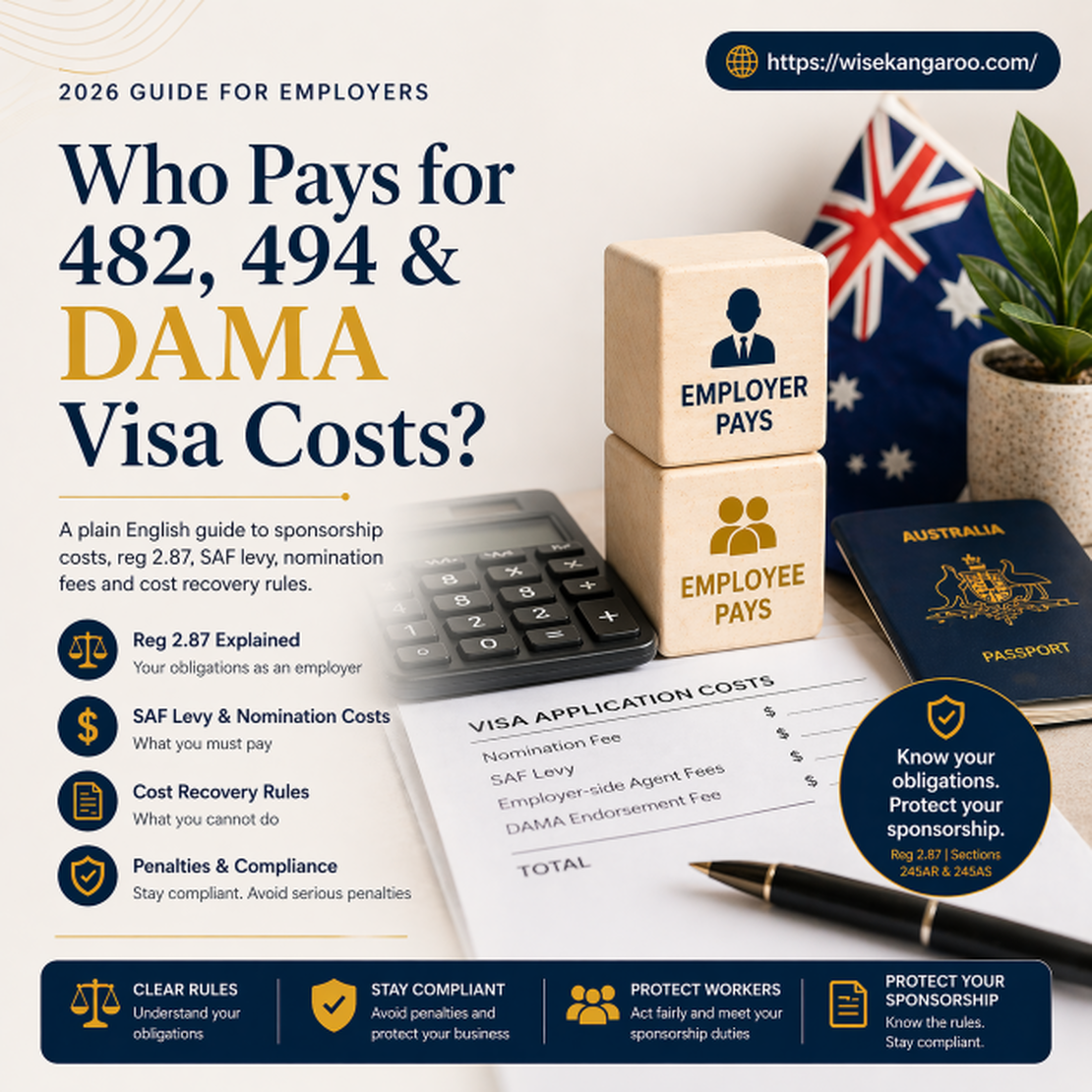
Who Pays for 482, 494 and DAMA Visa Costs? A 2026 Guide for Sponsoring Employers
A small business owner came to us recently wanting to sponsor a skilled worker through a Designated Area Migration Agreement (DAMA) pathway. His preferred deal was straightforward. The worker would pay for everything. She would cover the DAMA endorsement fee, the nomination fee, the Skilling Australians Fund (SAF) levy, and the migration agent’s fees for the employer side as well as her side of the work. The worker had agreed to all of it.
He was shocked when we told him the deal was unlawful. He thought surely he can pay for everything and then just deduct it from the workers salary in installments. We walked him through the rules and showed him why that would still be against the law. Ultimately the client decided to walk away when we stood our ground about the rules against transfer, recovery and payment of costs for sponsoring temporary workers.
This post sets out the rules we relied on, in plain English, for Australia’s temporary employer sponsored pathways such as the Skills in Demand visa (subclass 482), the subclass 494 Skilled Employer Sponsored Regional visa, and nominations lodged under a labour agreement such as a DAMA.
The Short Version
If you are sponsoring a worker on a temporary employer sponsored visa, you must pay for all costs related to the sponsorship and nomination yourself, including migration agent fees associated with these tasks. You cannot ask the worker to pay for those costs, even if the worker offers or agrees in writing. The worker may pay only their own visa application charge and personal costs such as migration agent fee, medicals, police checks, and English tests.
The specific rule that drives this outcome is regulation 2.87 of the Migration Regulations 1994. It applies to approved work sponsors (including Standard Business Sponsors and Accredited Sponsors) and to parties to a labour agreement such as a DAMA. Worker consent does not change the answer.
Sitting above regulation 2.87 is a broader Migration Act rule that applies to every employer sponsored nomination. Sections 245AR and 245AS of the Migration Act 1958 make it a criminal offence to ask for, receive, offer, or provide a benefit in return for a sponsorship related event. This anti-exploitation rule targets arrangements that use the nomination as leverage for an improper payment. It applies whether or not regulation 2.87 captures the specific cost.
Penalties for getting this wrong are serious. A civil contravention of regulation 2.87 can expose a corporate sponsor to penalties of around $99,000 per contravention. A contravention of section 245AR can result in up to two years’ imprisonment, fines of up to $118,800 for an individual, cancellation of sponsorship approval, and public naming on the Register of Sanctioned Sponsors.
The Rule That Does the Work: Regulation 2.87
Regulation 2.87 is the specific cost recovery prohibition for approved work sponsors. In plain English, it says that a sponsor cannot do any of the following:
- Recover from the worker the costs of becoming or being an approved work sponsor.
- Recover from the worker the costs of lodging a nomination, including the SAF levy and any migration agent or lawyer fees associated with recruiting and nominating the worker.
- Take any step that results in another person paying those costs on the employer’s behalf.
The regulation applies to:
- Approved work sponsors, which includes Standard Business Sponsors and Accredited Sponsors under the temporary skilled visa regime.
- Parties to a work agreement, which includes employers who hold a labour agreement such as a DAMA.
Two points matter in practice.
First, worker consent does not rescue a prohibited arrangement. The regulation applies even if the worker has signed a contract, agreed in an email, or offered to pay voluntarily. The Department’s approach is that the employer is in breach as soon as the employer takes a step that shifts a prohibited cost to the worker, regardless of how the worker responded.
Second, the prohibition is drafted to cover indirect recovery as well as direct recovery. A clawback clause that requires the worker to repay sponsorship costs on resignation, a wage deduction labelled “sponsorship recovery,” and an invoice for employer-side agent fees made out to the worker are all treated as breaches of the regulation.
The Anti-Exploitation Rule: Sections 245AR and 245AS
Sections 245AR and 245AS of the Migration Act sit alongside regulation 2.87 and cover a broader range of conduct. They prohibit asking for, receiving, offering, or providing a “benefit” in return for a sponsorship related event. They apply to everyone involved in the arrangement, including sponsors, nominators, migration agents, and labour-hire intermediaries.
The Department’s policy reads “benefit” narrowly in ordinary recruitment cases. Nomination fees, visa application charges, and reasonable migration agent fees paid in definite connection with finding and attracting the employee are not treated as a benefit for these sections. The sections bite on exploitative arrangements that extract value from the worker’s desire to secure the visa.
The Department’s published examples of conduct that does breach these sections include:
- A sponsor demanding a lump-sum cash payment upfront in exchange for agreeing to nominate the worker.
- Threatening to end the worker’s employment unless they return part of their salary each month.
- Continuing to sponsor a 482 holder only if the worker’s partner also works for the business for below-award wages.
- A labour-hire intermediary charging a large placement fee to connect the worker with an employer willing to sponsor them.
- An employer requiring the worker to pay the employer’s own tax and superannuation obligations as a condition of continued sponsorship.
- Agreeing to nominate a worker only if the worker accepts below-award wages and unpaid overtime.
The common thread is simple. A payment that has no genuine commercial connection to the cost of recruitment, and that uses the nomination as leverage, is an offence regardless of which temporary visa is involved.
What a 482, 494 or DAMA Sponsor Must Pay
If you are sponsoring a worker on a 482 Skills in Demand, 494 Regional, or labour agreement visa, the following costs are yours. They cannot be recovered from the worker, and the worker’s consent to pay does not change the position.
- Standard Business Sponsorship application fee (currently $420).
- Nomination application fee (currently $330 for a 482 nomination).
- SAF levy. On a 482 the levy is $1,200 per year of visa for a small business (turnover under $10 million), or $1,800 per year for larger businesses. On a 494 the levy is $3,000 for a small business or $5,000 for a larger business, paid once at nomination.
- Labour market testing costs, including advertising to satisfy the labour market test.
- DAMA or labour agreement endorsement fees (~$1000 in most DAMAs).
- Migration agent or lawyer fees for the sponsorship and nomination work. This covers drafting and lodging the sponsorship application, the nomination, and any labour agreement or DAMA request.
The Department’s “Cost of sponsoring” page carries the same list.
What the Worker May Pay
The employer may as the worker to pay their own personal costs. These fall outside regulation 2.87.
- The visa application charge for the primary applicant and any dependants.
- Medical examinations, police clearances, English tests, skills assessments, and translation costs for the worker’s own visa application.
- The worker’s own migration agent fees for the visa application, where the agent is acting for the worker on lodging the visa rather than on the employer’s sponsorship or nomination.
An employer can always pay more than the law requires. Many employers cover the primary visa application charge as part of a relocation package. The restriction runs only in one direction. An employer cannot pass its sponsorship and nomination costs down to the worker, but an employer can choose to cover more than the regulations ask.
The Clawback Clause Trap
The most common breach we see on 482 and 494 files is the clawback clause in the employment contract. These clauses say that if the worker leaves the business within a set period, often two to four years, the worker must repay part or all of the sponsorship and nomination costs.
Clawback clauses fail for three reasons:
- They shift sponsorship and nomination costs onto the worker, which regulation 2.87 prohibits.
- Worker consent does not rescue them. The regulation applies whether the worker agreed or not.
- Since 1 January 2025, a clawback executed through a wage deduction can also breach the Fair Work Act. An intentional underpayment under section 327A of the Fair Work Act 2009 is a criminal offence carrying up to 10 years’ imprisonment in serious cases.
If your current employment contracts contain clawback clauses tied to sponsorship status, review them before your next nomination.
Side-by-Side: Who Pays What
The table summarises the position for the two main temporary employer sponsored subclasses. Labour agreement and DAMA nominations follow the same rules as 494.
| Cost | 482 Skills in Demand | 494 Regional |
|---|---|---|
| Sponsorship application fee ($420) | Employer pays, cannot recover | Employer pays, cannot recover |
| Nomination application fee | Employer pays, cannot recover ($330) | Employer pays, cannot recover |
| SAF levy | Employer pays, cannot recover ($1,200 or $1,800 per year) | Employer pays, cannot recover ($3,000 or $5,000 once) |
| Labour market testing (advertising) | Employer pays, cannot recover | Employer pays, cannot recover |
| DAMA or labour agreement endorsement | Employer pays, cannot recover | Employer pays, cannot recover |
| Migration agent fees for the nomination | Employer pays, cannot recover | Employer pays, cannot recover |
| Visa application charge | Worker | Worker |
| Medicals, police, English, skills assessment | Worker | Worker |
| Migration agent fees for the worker’s own visa | Worker | Worker |
| Relocation (flights, removals) | Employer or worker by agreement; clawback tied to sponsorship status is high risk | Same |
A Real-World Scenario: The DAMA File We Walked Away From
Here is an anonymised version of the file that prompted this article.
A regional small business wanted to sponsor a skilled worker through a DAMA labour agreement under the 494 program. The worker was already in Australia on a separate temporary visa and very motivated to stay. She had told the employer she was willing to fund the entire process herself because it was her best pathway to permanent residence.
The employer’s preferred fee structure was:
- DAMA endorsement fee of about $1,100, paid by the worker.
- Employer-side migration agent fees for the DAMA and nomination work of about $6,600, paid by the worker.
- SAF levy of about $3,000 for the one-off 494 nomination, paid by the worker.
- The worker’s own visa application charge, medicals, police checks, English test, and skills assessment, also paid by the worker.
Every cost in the first three lines is a sponsorship or nomination cost caught by regulation 2.87, which applies to parties to a work agreement. A DAMA is a work agreement. Shifting those costs to the worker would have been an express breach, and the worker’s written consent would not have saved the employer.
We set out the compliant structure in writing:
- Employer pays: the DAMA endorsement fee, employer-side professional fees for the DAMA and nomination work, the nomination fee, and the SAF levy.
- Worker pays, through her own engagement letter: her own visa application charge, medicals, police checks, English test, skills assessment, and a separate migration agent fee for lodging the visa application.
The employer declined. We did not proceed. The commercial loss was real. The compliance protection was non-negotiable.
Three takeaways from the file:
- Worker enthusiasm does not waive the regulation. Regulation 2.87 binds the sponsor regardless of the worker’s consent. An eager candidate provides no defence.
- Small employers are the high-risk group. Larger corporates usually have internal HR controls that prevent clawback clauses and fee pass-throughs. Most breaches we see in practice involve small business owners running a first sponsorship.
- Losing a client beats losing a sponsorship approval. A registered migration agent or migration lawyer who structures a fee arrangement that facilitates the breach is also exposed, both under section 245AS and under their own professional conduct regulator.
The Cost of Getting It Wrong
A Commonwealth penalty unit has been $330 since 7 November 2024, with the next indexation due on 1 July 2026. On that basis, the exposure for a sponsor who recovers sponsorship or nomination costs from a worker includes:
- Civil penalty for breach of regulation 2.87: up to $19,800 per contravention for an individual, and up to around $99,000 per contravention for a corporate sponsor. Each breach is a separate contravention.
- Civil penalty under section 245AS: up to $79,200 for an individual and around $396,000 for a corporate.
- Criminal penalty under section 245AR: up to two years’ imprisonment, fines of up to $118,800 for an individual, or both.
- Infringement notices: under the Migration Amendment (Strengthening Employer Compliance) Act 2024, the Department can issue on-the-spot infringement notices for a range of sponsor compliance breaches without Federal Court proceedings.
- Administrative sanctions: cancellation of sponsorship approval, a bar on future sponsorship, and public listing on the Register of Sanctioned Sponsors.
- Impact on the worker’s application: a sponsor sanction can collapse a live nomination and any pending visa application, setting back the worker’s pathway by years.
These are real numbers. In 2016, three men were fined a combined $140,000 in the Federal Court for contraventions of section 245AS connected to a cash-for-visas scheme at a fruit-packing business in Tatura, Victoria. The Register of Sanctioned Sponsors has grown steadily since 2015, and the Australian Border Force continues to publish new entries.
The Fair Work Dimension
From 1 January 2025, intentional underpayment of a worker is a criminal offence under section 327A of the Fair Work Act 2009. Where a sponsor tries to recover sponsorship costs by deducting them from the worker’s wages, the deduction is almost certainly unlawful under sections 323 and 324 of the Fair Work Act, because it is not principally for the employee’s benefit. If the underpayment is intentional, it can also reach the criminal wage-theft offence.
What used to be a regulation 2.87 risk in isolation now carries compound exposure. Sponsor sanction under the Migration Act, and criminal wage-theft exposure under the Fair Work Act. Employers who previously treated clawback as a commercial judgment should revisit their contracts.
Structuring a Compliant Engagement
Before drafting the offer letter, the sponsorship application, or the engagement letter with your migration lawyer, work through four questions.
Step 1. Which visa? If it is 482, 494, or a nomination under a labour agreement (including a DAMA), regulation 2.87 applies and cost recovery from the worker is prohibited.
Step 2. Which costs are sponsorship or nomination costs? If the cost sits in the “Employer pays, cannot recover” column of the table above, your organisation pays it. Personal worker costs (visa application charge, medicals, police, English, skills assessment, the worker’s own agent) are payable by the worker.
Step 3. Who does the migration agent act for? If the scope of the agent’s work is the sponsorship and nomination, the agent acts for the employer and the fee belongs on the employer’s side. If the scope is the worker’s own visa application, the agent acts for the worker and the worker can pay. If the engagement covers both, document the split with separate engagement letters.
Step 4. Document the arrangement. Use separate engagement letters, separate invoices, and an employment contract that contains no clawback clauses tied to sponsorship status.
Frequently Asked Questions
Q: Can my employer make me pay the 482 nomination fee or the SAF levy? A: No. Regulation 2.87 of the Migration Regulations 1994 prohibits an approved work sponsor from recovering or transferring the cost of the sponsorship, the nomination, or the SAF levy to a 482 or 494 worker. Worker consent does not override the prohibition. The worker can pay only their own visa application charge and personal costs such as medicals, police checks, English testing and their agent fees.
Q: Can a sponsored worker be asked to pay migration agent fees? A: On a 482 or 494 nomination, or any labour agreement or DAMA, regulation 2.87 prohibits the employer from recovering employer-side migration agent fees from the worker. Those fees belong on the employer’s invoice. The worker can separately pay an agent for work on the worker’s own visa application, where the agent is acting for the worker personally on lodging the visa rather than on the employer’s sponsorship or nomination.
Q: Can I agree in writing to repay my 482 sponsorship or nomination costs if I leave within two years? A: No. Regulation 2.87 applies whether you consent or not. A contract clause that requires you to repay sponsorship or nomination costs is unenforceable, and it exposes your employer to a sponsor sanction. Since 1 January 2025, a repayment executed as a wage deduction can also breach the criminal wage-theft provisions of the Fair Work Act.
Q: My employer already deducted visa costs from my pay. What can I do? A: Keep your payslips, your employment contract, and any written communications about the deduction. You can lodge a complaint with the Fair Work Ombudsman, and you can report sponsor non-compliance through the Department of Home Affairs reporting form. Reporting a non-compliant sponsor does not put your visa at risk. You may also have a civil claim to recover the amounts deducted.
Q: Does the Skills in Demand rebrand change any of this? A: No. The 482 was rebranded as the Skills in Demand visa from 7 December 2024, with three operational streams: Core Skills, Specialist Skills, and Labour Agreement. Regulation 2.87 was not amended and continues to apply to every Skills in Demand nomination.
Q: Can my employer voluntarily pay my visa application charge and medicals? A: Yes. Regulation 2.87 sets a floor, and an employer can always pay more than the law requires. Many employers cover the primary visa application charge as part of a relocation package. The restriction runs only in one direction. The employer cannot pass its own sponsorship and nomination costs down to the worker.
Coming Next: What About Permanent Employer Sponsored Visas?
The rules covered above are specific to temporary employer sponsored visas. The permanent Employer Nomination Scheme sits in a different part of the Migration Regulations, and the cost recovery position can vary by nomination stream. The short answer is that the analysis is not always the same as for 482 and 494, and some permanent pathways allow the worker to fund more of the nomination process while others follow the temporary stream closely.
Watch this space for a dedicated post that works through the permanent Employer Nominated streams in detail. If you are planning a permanent employer sponsored nomination and want a fee structure signed off for your specific scenario, get in touch and we will walk you through the position.
Get Advice Before You Draft the Offer Letter
Sponsor compliance is a strict liability regime, and the consequences of breach can be significant and reputationally damaging. Most of the breaches we see are unintentional. A small business owner applies an ordinary commercial instinct, that the person who benefits should pay, to a regime where that instinct is unlawful. The cost of getting it right is a short conversation with an experienced Registered Migration Agent or migration lawyer. The cost of getting it wrong is a public sanction, penalties in the tens or hundreds of thousands of dollars, and in the worst case criminal exposure for company directors.
If you are an employer considering a 482, 494, or DAMA sponsorship, or a worker who has been asked to pay costs that do not feel right, get in touch. We will structure the engagement so that the sponsorship, the nomination, and the visa application are each invoiced to the right person, and the paper trail is clean.
This article is for general information only and is current as of 22 April 2026. It is not legal advice and does not create a solicitor–client or migration agent–client relationship. For advice specific to your circumstances, consult a Registered Migration Agent or migration lawyer. Always verify current fees and regulatory requirements with the Department of Home Affairs before lodging.